 LandOffer
Job search
How to Tailor Your Resume to a Job Description Without Inventing Experience
Select, reorder and clarify supported experience while keeping factual career identity and contribution scope intact.
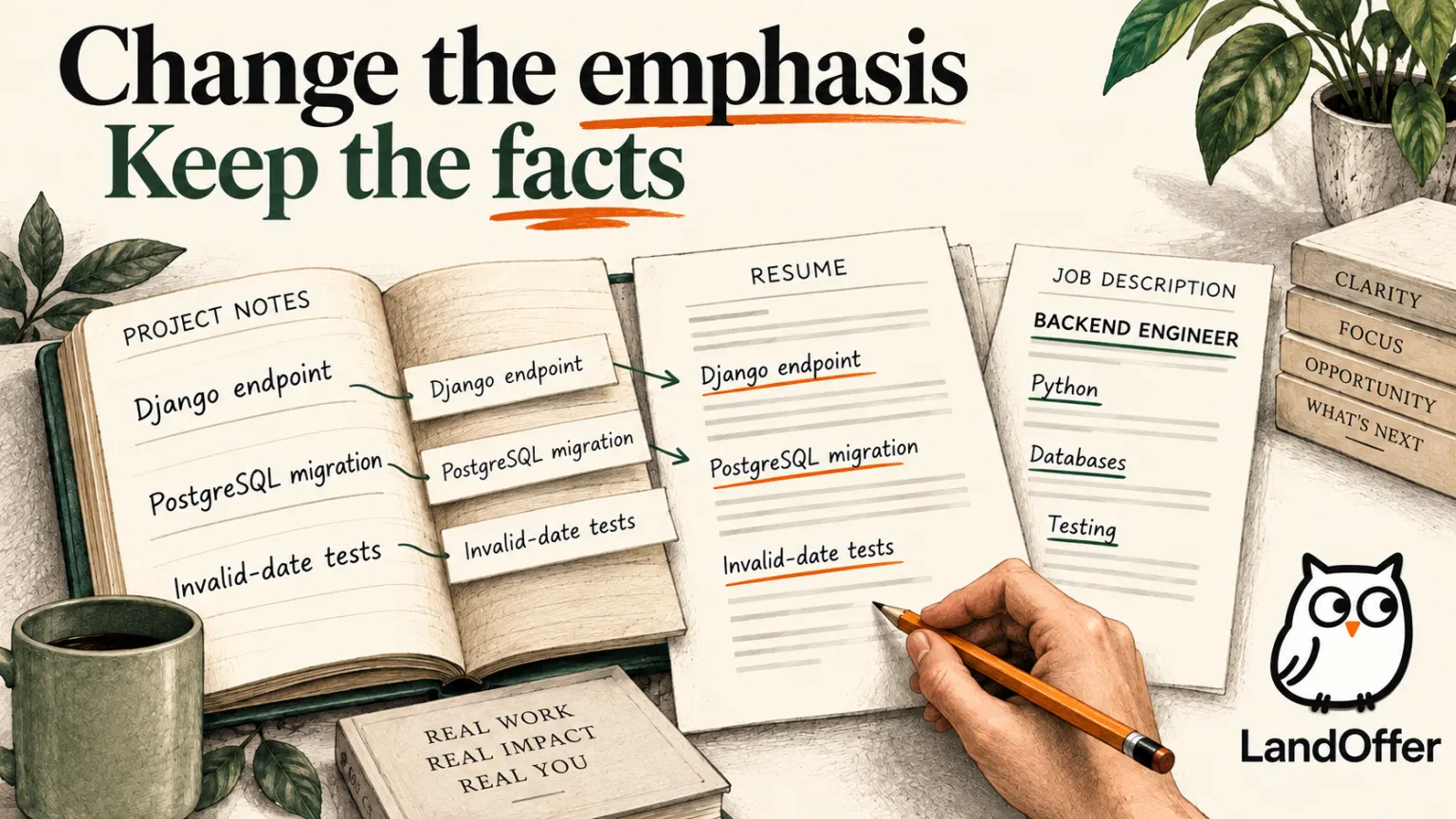
Tailor your resume by selecting relevant experience, making existing evidence explicit, and changing the order or emphasis of your writing. Keep employers, titles, dates, skills, responsibilities, and results grounded in what actually happened. A requirement you cannot support is a gap to assess, not an instruction to invent a matching claim.
Start with one real description, perhaps from recent roles on LandOffer, and compare it with your own project and employment records. LandOffer publishes this guide. Sources were checked on October 8, 2026. The worked candidate below is fictional; the examples are editorial rewrites, not measured output from a resume tool or a guarantee of employer acceptance.
Decide whether the job is worth tailoring for
Before editing, check the role's location, work arrangement, experience expectations, and central responsibilities. If a mandatory condition excludes you, rewriting the resume does not resolve it. If the role is broadly relevant but one preferred technology is missing, inspect the rest of the requirements before deciding whether that gap outweighs your relevant experience.
Read the description as a description of work, not just a collection of searchable words. A backend role may emphasize building APIs, investigating failures, collaborating on data models, and maintaining a service. Those tasks give you a better basis for selecting evidence than repeatedly inserting “backend” into unrelated bullets. Separate stated requirements from nice-to-have tools and broad company language.
MIT's career-writing guidance describes a resume as a factual account of experience, skills, and achievements and recommends tailoring application materials to the job. That principle supports relevance and careful checking; it does not authorize changing a career history to resemble the posting.
Save the description with its employer and requisition. If the text changes or disappears, you will still know which requirements shaped this version. Keep this reference separate from the resume itself. A large pasted job description is useful in your notes, but it does not belong in the document you submit as your own experience.
Build a requirement-to-evidence map before writing
Make three categories: evidence already visible in the resume, evidence that exists but is poorly described, and requirements with no supporting experience. The second category is where tailoring often makes the clearest improvement. It lets you recover relevant facts from project notes, reviews, or your own recollection instead of asking a writing tool to fill an empty space.
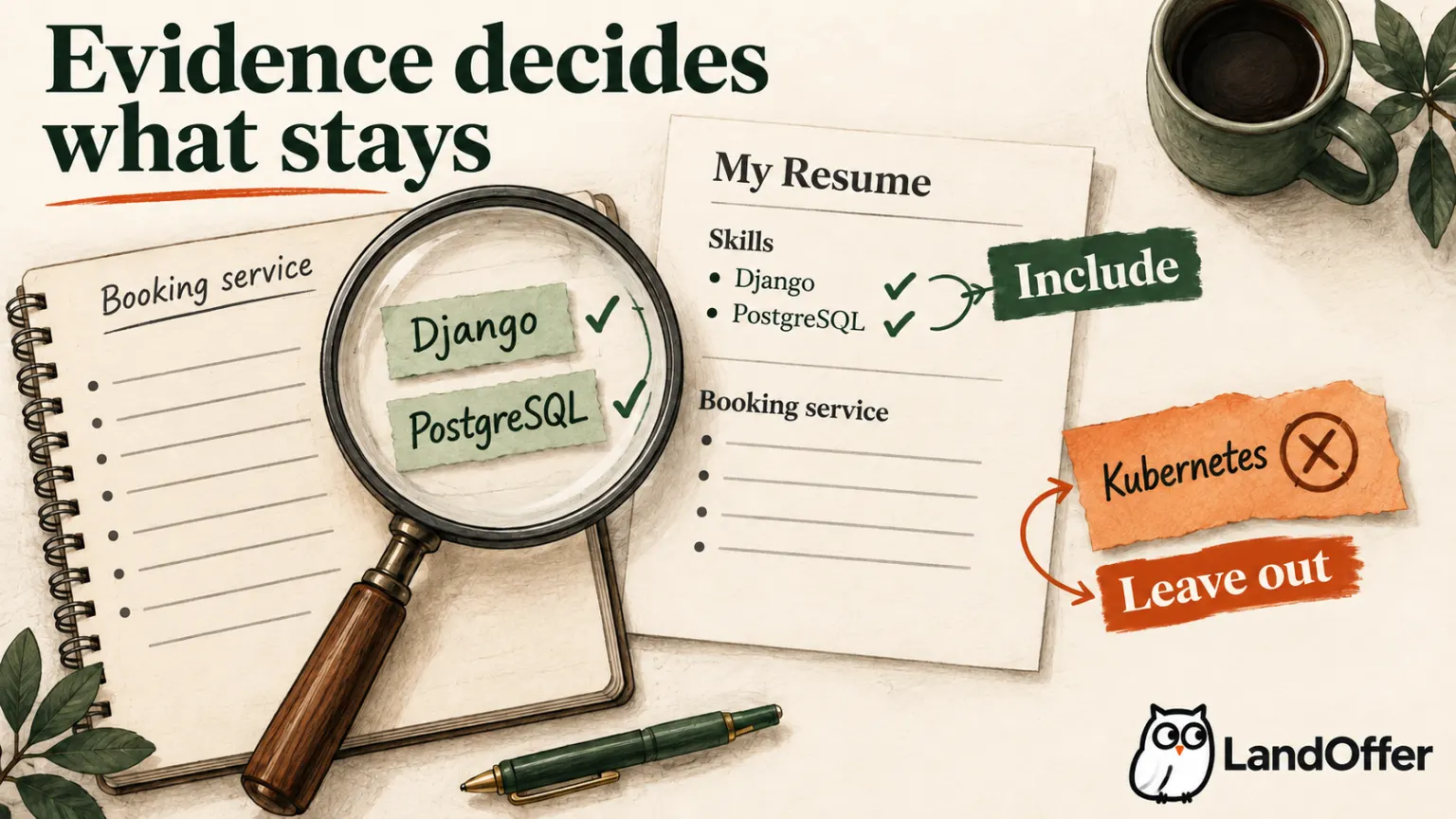
Here is a fictional case. Dana is applying for a Backend Engineer position at Alder Services, requisition AS-26. The description asks for Python web development, relational databases, automated testing, and investigation of service failures. Kubernetes is preferred. Dana's internship records show a Django endpoint, PostgreSQL migrations, tests for invalid inputs, and log-based debugging. Dana has not used Kubernetes.
| Requirement | Dana's available evidence | Resume decision |
|---|---|---|
| Python web development | Implemented a Django endpoint for an internal booking service | Name Python and Django in a specific contribution. |
| Relational databases | Wrote a PostgreSQL migration and checked existing records | Describe the database change and verification. |
| Automated testing | Added tests for missing and invalid booking dates | Show what the tests checked. |
| Failure investigation | Reproduced a failed request from logs and corrected validation | Explain the diagnosis and bounded correction. |
| Kubernetes | No use in employment, coursework, or personal projects | Leave it out; evaluate the preferred-skill gap honestly. |
This map yields four relevant evidence areas and one real gap. It does not establish that Dana meets every requirement or that Alder will interview Dana. Its useful result is a writing plan: which facts deserve space and which requested skill must remain absent. That is more actionable than a vague instruction to make the resume sound technical.
For your own map, identify a concrete source behind each claim. You do not need to submit private performance reviews or internal tickets with the application. The source is a checking aid. Avoid moving confidential material into a third-party tool merely because it would make the prompt more detailed; an accurate, nonconfidential summary can often support the edit.
Rewrite the relevant section without expanding the facts
Dana's original internship section reads:
Software Engineering Intern, Alderbridge Studio — June–August 2025
Worked on backend features and database tasks.
Helped improve quality and fix bugs.
Technologies: Python, Django, PostgreSQL, Git.
The section contains relevant tools but gives the reader little sense of Dana's contribution. A tailored version can preserve the same title, employer, dates, and technology list while explaining the work:
Software Engineering Intern, Alderbridge Studio — June–August 2025
Implemented a Python/Django endpoint for an internal booking service and added tests for missing or invalid booking dates.
Wrote a PostgreSQL migration for booking-status records and checked existing records against the new schema.
Reproduced a failed booking request from service logs and corrected the validation path that caused the error.
Technologies: Python, Django, PostgreSQL, Git.
This is an editorial example, not generated Simplify, Teal, or LandOffer output. It adds specificity from the stated evidence. It does not add user counts, latency improvements, production scale, ownership of the whole service, or a team-lead claim. The stronger section helps a reader understand relevant work without changing the underlying employment record.
The verbs also preserve Dana's contribution boundary. “Implemented an endpoint” describes a component. “Architected the platform” would describe a much larger responsibility and is unsupported here. A resume can show initiative without claiming sole ownership of a team result. If a teammate designed the database schema, Dana should not convert implementing a migration into designing the entire data model.
Change emphasis across the document, not only inside a bullet
Tailoring includes choosing what leads each section. For this backend role, Dana places the endpoint and database work before a less relevant design-club project. For a different role focused on frontend accessibility, a verified interface project might deserve more space. The experience does not change; the relevance of each detail changes with the reader's task.
Preserve a clear chronology within employment history rather than moving an older job into the newest position. You can reorder contribution bullets under a role, choose a more relevant project first in a separate Projects section, or adjust section order when it helps the reader. Keep dates visible so that emphasis does not distort when or where the work occurred.
A summary is optional. If Dana uses one, it might say “Software engineer with internship experience building Python/Django service features and PostgreSQL database changes.” It should not say “Senior backend engineer” merely because the target title contains senior. If a summary adds only broad adjectives, the concrete section above may do the work more effectively without it.
Skills should agree with the experience examples. Move relevant tools earlier in the list when they are genuinely part of your work, but do not add an entire requested stack to make the list longer. Distinguish employment experience, coursework, and personal projects when that context matters. A weekend tutorial can demonstrate learning; it is not equivalent to operating the same technology professionally.
Use a writing tool with a bounded source and instruction
If you use AI, give it the relevant requirements and a factual account of your work, then specify what may change. For example: “Rewrite these three bullets for clarity and relevance to Python backend work. Use only the facts below. Keep my contribution scope and dates unchanged. Flag missing requirements separately. Do not add technologies, metrics, or leadership.” This is a suggested instruction, not a promise that a model will obey it.
Review every resulting sentence against your evidence map. A polished sentence can quietly add a claim through a single verb: “led,” “owned,” “deployed,” or “scaled.” Check nouns too. “Customers” is different from internal colleagues; “production” is different from a class project; “platform” can imply more scope than an endpoint. These changes deserve the same scrutiny as an invented percentage.
Teal's tailoring guidance distinguishes existing master-resume content from missing skills and explicitly cautions against pretending to have experience with an unfamiliar tool. Its documented workflow provides one way to select relevant material. The general lesson is to supply the facts first, then review the selection and wording rather than accept every suggestion.
Simplify's tailoring documentation says it saves a tailored version separately while retaining the original. That is a useful documented versioning distinction, not evidence that a rewrite is always accurate. Regardless of the tool, keep an unchanged base and inspect the actual exported file before using the new version.
Handle numbers, titles, and missing requirements carefully
Use measurements when you can explain their basis. If you have a recorded before-and-after runtime, describe the task, conditions, and result accurately. If you have no reliable measurement, describe scope and verification instead. Dana's invalid-date tests and checked database records are useful details without an invented “40% quality improvement.” A numeric result is not mandatory in every bullet.
Keep an official employment title accurate. If an internal title is obscure, a truthful functional clarification can help, such as “Associate II — backend development,” when that description reflects the work. Do not replace it with the target title merely to satisfy a matching report. The reader should be able to reconcile the resume with your explanation and employment history.
For a missing requirement, decide whether it is central to the job. Kubernetes may be a preferred skill in Dana's example, while Python service development is core. That distinction can support applying with an honest gap, but it does not guarantee the employer will overlook it. If a posting requires experience you do not have, no synonym or summary line can supply that experience.
Learning plans belong in the appropriate context. If you are studying Kubernetes, you may describe an actual completed exercise under projects or education when useful. Do not list planned learning as current proficiency. Separate “built a local practice deployment” from “operated a production cluster”; the boundary communicates more than an unqualified tool name.
Finish with a factual and file-level review
Read the tailored version without the job description beside it. Does each bullet describe work, or has it become a mirror of the employer's vocabulary? Then compare it with the source map again. Check dates, title, contribution scope, tool names, and any numbers. Ask yourself what you would say if an interviewer requested the implementation details behind each line.
Open the exported resume and inspect the reading order, characters, links, and page breaks. When an application imports fields, review the visible values rather than assume that a readable PDF parsed correctly. Greenhouse's parsing guidance documents failures and partial imports caused by several formatting patterns. That supports checking the result, not a claim that one layout guarantees compatibility everywhere.
Save a distinct filename associated with the employer and requisition, and keep the exact submitted file with your application record. Exporting a file does not submit an application. If you later receive an interview invitation, you can prepare from what the employer received rather than reconstructing which version seemed most relevant at the time.
For your next application, choose a role worth pursuing, build its requirement-to-evidence map, and rewrite only from supported facts. Browse recent roles on LandOffer if you need a description to work from, then open the employer posting and tailor to the actual responsibilities. Stop when the document is relevant, readable, and explainable—not when every requested word has appeared.
Sources and Further Reading
- MIT career-writing guidance — factual application materials and tailoring.
- Teal: Tailor your resume for a specific job — selecting existing content and handling real gaps.
- Simplify: Resume tailoring — separate tailored versions and review.
- Greenhouse: Unsuccessful resume parse — formatting and imported-field limitations.