 LandOffer
Job search
A New-Grad Tech Job Search Plan: Find Roles, Check Eligibility, and Apply Carefully
Build a weekly search from supported graduation and availability dates, distinct role types, evidence packs and confirmed submissions, without a universal quota.

Build a new-grad tech search around three decisions: which kinds of roles you can support with your experience, whether each opening accepts your graduation and availability dates, and what its application actually requires. Find opportunities through employer pages, relevant boards, and your school's available resources, then give eligible applications enough time for accurate review and submission.
There is no universal graduation window, recruiting calendar, or weekly application quota. A useful plan produces checked opportunities and completed next actions while preserving the difference between student eligibility, job requirements, and your own schedule.
Start a discovery session with LandOffer's recent roles, then open the employer's listing. This guide uses current public employer and university instructions as examples. The candidate, sample employers, dates, replies, and weekly outcomes below are fictional, not candidate reports or a measured placement study.
Write your search facts before opening more tabs
Record your expected degree and graduation date exactly as supported by your current academic record. Keep expected graduation separate from a degree already conferred. If your academic plan changes, update the search record and any affected application drafts rather than leaving a favorable older date in place.
Then record when you can actually start, locations you can accept, attendance arrangements you can meet, and your work-authorization circumstances. Do not use a graduation date as a substitute for availability: exams, a current commitment, or a move may create a gap. Answer eligibility and authorization questions according to their wording; seek appropriate guidance when your own answer is unclear.
Choose a primary role family by the work you can demonstrate. For software roles, that might be implementing and testing a service. For data roles, it might be querying records, checking an analysis, or diagnosing an import problem. Naming the work you can explain gives you useful search terms beyond “tech.”
Keep one adjacent family if you have evidence for it. You might explore junior software roles and data engineering roles because a project involved both an API and data validation. Product analytics would need its own relevant analysis evidence. An adjacent family widens discovery while keeping the evidence check manageable; it should still connect to work you can demonstrate.
Separate graduate, entry-level and internship eligibility
A graduate program can restrict enrollment, graduation timing, geography, and start date. An entry-level role can use different qualifications without a formal cohort. An internship may require returning to school afterward. Treat these as different opportunities rather than interchangeable ways to enter the same employer.
For a current concrete example, Atlassian's Software Engineer, 2027 Graduate U.S. posting lists full-time enrollment in a relevant bachelor's or master's program and graduation by August 2027 among its minimum qualifications. It also identifies Seattle as the role's location and includes role-specific work-authorization restrictions. That is one opening's description checked October 8, 2026, not a graduation rule for all tech employers.
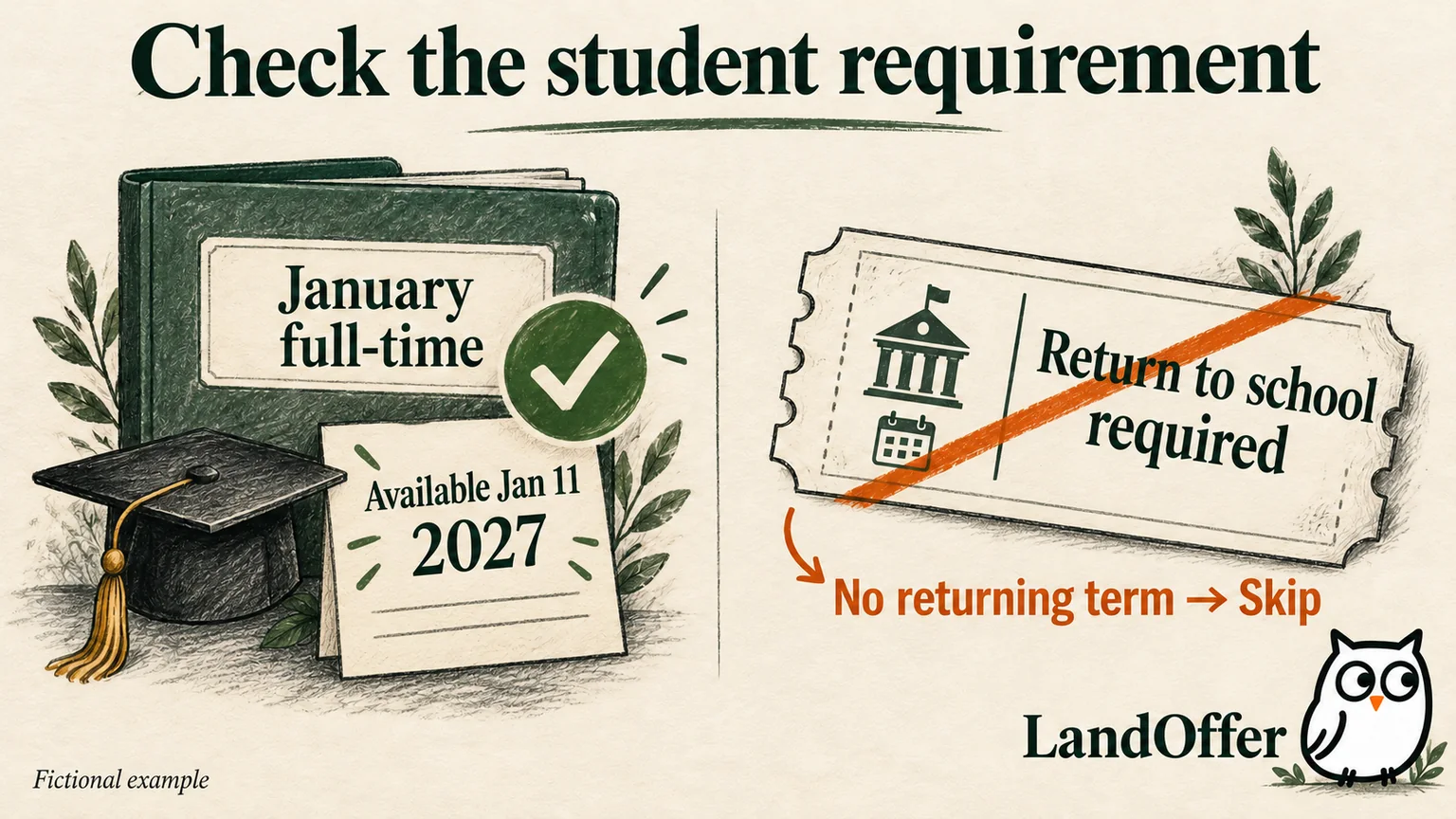
Microsoft's internship eligibility page separately states that its University Interns in the United States, Canada, and Latin America must be enrolled full time in the preceding academic term and return to school for a full academic term afterward. For that program, a candidate with no academic term after the internship would not meet its stated return-to-school rule. These internship rules do not determine eligibility for Microsoft's full-time graduate jobs.
Read dates literally. “Graduate by August” and “graduate between May and September” impose different conditions. Likewise, “start in January” differs from “available immediately.” A familiar program name, a friend's eligibility, or a job-board class-year tag cannot resolve a conflict in your own record.
Put a material unknown on hold with a named question. If the employer publishes a candidate contact route, ask about the specific opening and your actual date. If no answer is available, preserve the unknown and prioritize applications whose requirements you can establish. Do not select a convenient date to bypass a required field.
Find openings through distinct channels
Use employer early-career pages to find formal programs and their current listings. Search boards for responsibility-based terms as well as labels such as graduate, junior, associate, or engineer I. Broader titles can uncover appropriate work, but each still needs a qualification check. A title alone does not establish the level.
Your school's career service may provide a campus platform, employer events, advising, and eligibility-restricted recruiting. Check your actual access rather than assuming every recent graduate can use every school service. Alumni access, participating programs, and employer restrictions can differ.
Harvard's Crimson Careers instructions show one campus setup: students can filter by class level and other criteria, and an employer may collect materials on the platform or redirect applicants to its own site. These are useful distinctions to investigate in your school's system, not a claim that your portal uses Harvard's interface.
Give each channel a purpose. Employer pages establish the current source and route. Boards broaden discovery. A campus event can help clarify a program's timing or responsibilities. Merge repeated discoveries of the same employer requisition into one opportunity record rather than counting every card as new work. For recurring discovery, use the job-alert setup guide; an alert produces leads that still need your eligibility check.
Keep recruiting dates attached to the program and location that published them. Do not postpone a suitable current opening because a blog says all new-grad hiring starts in one month. Equally, a dated general program page does not prove that a particular cohort is accepting applications today.
Classify Priya's five fictional opportunities
Priya expects a bachelor's degree in computer engineering on December 18, 2026, can start January 11, 2027, and accepts Seattle onsite or hybrid work. Priya has a Python course project that checks sensor readings, SQL coursework with a documented analysis, and a part-time campus IT role. Priya cannot return to school after a summer 2027 internship.
For this teaching example, Priya meets the mock listings' stated authorization conditions. That assumption is included only to isolate the graduation and availability decisions. It is not a suggestion to infer a real candidate's legal eligibility from their location or degree.
A role can look promising until one date disqualifies it. Recording that reason lets you move on without repeatedly reopening the same listing. On October 12, Priya checks five fictional employer listings. Their invented date conditions and application instructions produce the following decisions.
| Mock opening | Actual condition in the fictional listing | Priya's classification |
|---|---|---|
| Northstar Tools, NG-101, Graduate Software Engineer | Graduation September 1, 2026–August 31, 2027; January 11, 2027 start; Seattle; Python project evidence accepted | Eligible to prepare; December graduation and January availability fit |
| Summit Compute, IN-22, Summer 2027 Intern | Must return for a full academic term after the internship | Skip; no returning term |
| Quartz Mobile, QA-8, Graduate Engineer | Graduation May–September 2027 | Skip; December 2026 falls outside the window |
| Willow Metrics, WM-12, Junior Analyst | Start November 2, 2026; flexibility not stated | Hold; ask whether January 11 is acceptable |
| Ridge Data, DA-18, Junior Data Analyst | Relevant degree completed before January 11, 2027 start; SQL analysis and Python; no fixed class-year window | Eligible to prepare; choose evidence relevant to analysis |
“Eligible to prepare” means these stated gates pass in the example. It does not mean the employer will select Priya. Northstar's technical responsibilities still need an evidence check, and Ridge's analysis application should not simply receive the identical software resume.
Willow demonstrates a resolved question. In the fictional scenario, Priya asks through the listed candidate contact on October 13. The mock employer replies October 14 that November 2 is required and January 11 cannot be accommodated. Priya changes Hold to Skip and records the dated reason. A response changed the decision; guessing did not.
Prepare a small evidence pack before tailoring
Collect a factual master resume, your academic dates, relevant project notes, and the artifacts you can share appropriately. For each project, distinguish your own contribution from the team's. Preserve the problem, your decision, the check you performed, and its observed result. A working class demo is evidence of a class demo, not a customer deployment.
Priya's Python notes show unit checks and out-of-range flags for a local sensor dataset, with tests for both conditions. The SQL analysis groups campus-library loan counts and includes manually checked totals for two sample weeks. The campus IT record shows troubleshooting and user communication. None establishes commercial platform ownership, a revenue increase, or years of professional data engineering.
Northstar receives emphasis on implementation, validation, and testing. Ridge receives emphasis on SQL analysis and careful checking of records, with Python as supporting evidence. Priya keeps dates and experience consistent between versions. The change is relevance, not a different biography.
Inspect required materials before estimating effort. Some applications request transcripts, a portfolio, or short answers; others do not. Supply the requested version and format. Review the complete exported file and any parsed education or experience fields. A saved master document does not prove that the attachment selected for this employer is correct.
Finish a realistic week, then inspect its results
Priya has seven hours, or 420 minutes, available during October 12–18, 2026. The following completed fictional week uses planning blocks rather than promising a fixed volume. Classwork and other commitments occupy the remaining time.
- Monday, 60 minutes: discover and merge leads, open current employer sources, and record the five opportunity decisions.
- Tuesday, 75 minutes: check academic and start dates, inspect both eligible applications' requirements, and send Willow's specific availability question.
- Wednesday, 100 minutes: select truthful evidence for Northstar and Ridge, prepare their resume versions and required answers, and record Willow's negative reply.
- Thursday, 90 minutes: review Northstar's complete application, submit it before its fictional October 15 deadline, and preserve its matching receipt.
- Friday, 55 minutes: review and submit Ridge's application, preserve its matching receipt, and check whether it includes an assessment instruction or deadline.
- Saturday, 40 minutes: reconcile the records, identify unfinished actions, and reserve next week's preparation blocks.
The blocks total 420 minutes. Priya ends with two confirmed submissions and three explained exclusions. No interview outcome is invented. Another candidate's week might reasonably produce one demanding application, several shorter applications, or only clarification and preparation. Capacity and required work determine the plan.
If Northstar requires more work than its assigned block, Priya must revise the plan before the deadline. Moving Ridge to the next available session is a defensible response. Cutting factual review to protect a count of two would undermine the reason for planning.
Keep campus and employer tasks separate when instructions require both. Harvard's campus recruiting FAQ says that applicants must complete both routes for a campus interview when the employer requires an additional company-site application. That is a specific process rule. Read your own school's instructions, and do not assume one submission covers another destination.
Let the next week respond to evidence
At the weekly review, inspect outcomes you can actually identify: unique suitable openings found, eligibility questions resolved, reviewed applications submitted, and outstanding employer instructions. A saved job is not a submission. A confirmation is not an interview. A portal silence is not proof of rejection or of a failed application.
When the queue is mostly internships requiring a returning term, refine discovery toward full-time graduate or entry-level openings. When dates conflict, adjust the program search while preserving your real graduation and availability. When applications repeatedly require evidence you lack, reconsider the role family or build an honest project with a bounded result.
Protect time for assessments and interviews if invitations arrive. Read their actual deadlines, allowed tools, and required steps before replacing planned discovery blocks. Your weekly schedule is flexible; an employer's stated requirement is a separate input.
Take one role from LandOffer's recent jobs and write down its graduation rule, start requirement, location, and application destination. Classify it using your own supported facts, then reserve a complete review block if it belongs in your queue. If an essential condition remains unknown, keep the role on hold and choose a checked opening for the next preparation block.
Sources and Further Reading
- Atlassian: Software Engineer, 2027 Graduate U.S.: one current role's enrollment, graduation, location, and qualification conditions, checked October 8, 2026.
- Microsoft: Internship Eligibility and Qualifications: region-specific enrollment and return-to-school conditions for University Interns; separate from full-time graduate eligibility.
- Harvard Mignone Center: Crimson Careers: campus discovery, materials, application destinations, and explicit submission.
- Harvard Mignone Center: Recruiting Frequently Asked Questions: Harvard's specified campus and employer application requirements; not a universal dual-application rule.