 LandOffer
Job search
From Research CV to Industry Resume: A Job Search Workflow for Graduate Students
Translate graduate research into an industry resume with a completed evidence map, truthful bullets, separate skill practice and clear degree timing.
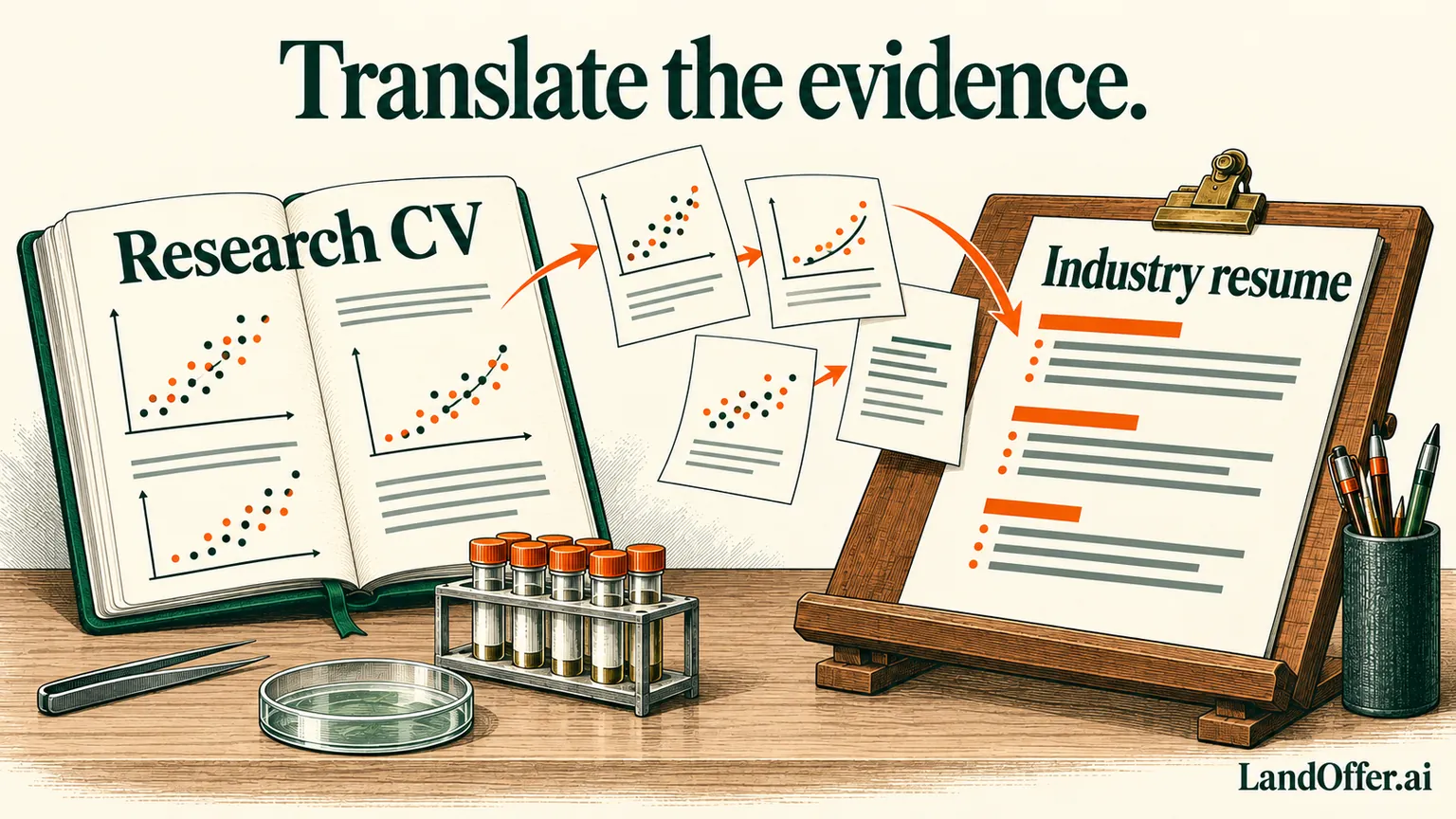
To move from a research CV to an industry resume, choose a specific role family, identify the work your research can support, and select evidence that explains your contribution to that work. Preserve academic titles, degree status and collaboration boundaries. Translation should make the experience understandable outside your field; it should not turn laboratory work into commercial deployment or imply that a degree is already complete.
Use a few recent roles on LandOffer.ai to inspect actual responsibilities before editing your CV. LandOffer publishes this guide. University career guidance was checked October 9, 2026. Priya Sen, Westhaven University and all research, project and posting details below are fictional teaching inputs. No industry application or hiring outcome was observed.
Choose the work before choosing the document
“Industry” includes many different jobs. A research scientist, manufacturing analyst, software engineer and technical program manager may all value graduate experience for different reasons. Start with the outputs each role expects: a research finding, a dependable service, an analysis supporting an operational choice or coordination across teams.
Read several descriptions in the same role family. Extract recurring responsibilities, required experience, location and availability conditions. Separate explicit requirements from preferences. A PhD may be relevant to a research position without replacing production experience in an engineering opening. Conversely, a role may make strong use of your analysis and communication even without requiring your specialization.
MIT's industry-resume module for PhDs treats the choice between CV and resume as a task to resolve, not a universal rule that all documents must look alike. Follow the employer's instructions. An industry research opening might request a CV or publication information; another asks for a concise resume.
The first decision is therefore a role hypothesis you can test against your evidence. “Manufacturing analytics roles using experimental data” gives you a selection rule. A broad interest in AI still needs a target responsibility before it can guide page space or preparation.
Build an evidence bank without destroying the master CV
Maintain the full academic record separately from each application document. Princeton's CV-to-resume guide recommends starting from an updated master CV and selecting relevant elements for role-specific resumes. That preserves material you may need for another audience.
For each experience, record the problem, your contribution, methods, completed output and evidence you can discuss. Include teaching, lab coordination or service when those activities demonstrate responsibilities relevant to a target role. Teaching and lab coordination can also reveal how you explain work, organize tasks or help others use a method, when those duties matter to the role.
Keep attribution beside the achievement. Who designed the experiment? Who wrote the code? Who decided which result mattered? Distinguish the advisor's research agenda, the group's paper and your own implementation. If you contributed a data-cleaning method to a shared study, say that rather than claiming the entire discovery.
Add confidentiality and sharing limits to the bank. A public publication link may be appropriate while raw participant records, collaborator files or unpublished results are not. You can explain a method with a permitted or synthetic example instead of uploading restricted research to a resume tool.
Complete a research-to-role selection map
Fictional Priya is a materials-science doctoral student expecting to complete her degree in May 2027. Her research includes Python and pandas analysis of repeated lab experiments, plotting and a documented review process with her advisor. Her research evidence bank contains no SQL work, production model deployment or ownership of a customer-facing service.
She compares three fictional role descriptions before drafting. All responsibilities below are stipulated for the example, not descriptions of current vacancies.
| Role under consideration | Evidence Priya has | Material gap or condition | Decision for this search |
|---|---|---|---|
| Manufacturing data analyst using experiment results; SQL required | Python cleaning, repeated-run comparison and explaining measurement limits | SQL is absent from her research record; May 2027 start must fit | Primary track, with the SQL gap explicit and start date checked |
| Research associate in materials characterization | Direct domain research and experimental interpretation | Degree-completion and method requirements need comparison with the specific posting | Second track with a separate document emphasizing relevant methods |
| ML engineer owning production inference services | Analysis and scientific reasoning | No demonstrated model-serving, monitoring or production-service ownership | Lower priority; do not relabel research as deployment experience |
The map does not certify her eligibility. It shows where the current evidence is relevant and what still needs resolution. Priya chooses the analytics track for her first resume because she can explain the work behind its main analysis responsibilities, while acknowledging that SQL needs separate evidence.
Her research-associate version would retain more scientific context. Her analytics version would foreground data preparation, comparisons and communicating limits. The facts stay the same across both versions. The ML-engineering description is not rejected because the title sounds difficult; its missing production responsibilities explain the decision.
Translate a research contribution into finished resume content
Priya's original CV entry reads: “Graduate Research Assistant, Materials Characterization Laboratory; dissertation on thermal response in composite samples; conference presentation and coauthored manuscript.” That identifies the academic setting but leaves an industry reader guessing what she personally did.
Her fictional evidence bank adds that she wrote the pandas cleaning steps, retained experiment identifiers, flagged missing measurement fields and compared repeated runs without pooling different test conditions. Her advisor selected the scientific direction, and a lab technician operated the instrument. The following excerpt uses only those stipulated facts.
Graduate Research Assistant — Westhaven University
September 2023–present
• Built a Python/pandas cleaning workflow for repeated composite-sample experiments, preserving experiment identifiers and flagging missing measurement fields before comparison.
• Compared repeated runs within the same test conditions and documented excluded records, allowing the advisor to review which observations supported each plotted result.
• Presented the analysis and measurement limits at a departmental research session; contributed the data-preparation description to a coauthored manuscript.
This is finished content, but not a complete resume template to copy unchanged. It preserves the actual academic title and describes the setting without assuming that an employer knows the dissertation topic. The first bullet explains an implementation, the second a methodological choice, and the third a communication output.
No commercial users, revenue, percentage improvement or production reliability claim has been added. If Priya later finds a defensible count in her records, she can include it with context. A number should clarify scale or result, not decorate a sentence whose central action is still unclear.
Harvard's 2026 graduate-industry resume panel recap recommends connecting project, action and result and preparing to discuss listed experiences. Treat that as career advice from the panel, not measured proof that a particular bullet format wins interviews. Priya can explain every step in this excerpt from her evidence bank.
Keep new technical practice separate from research
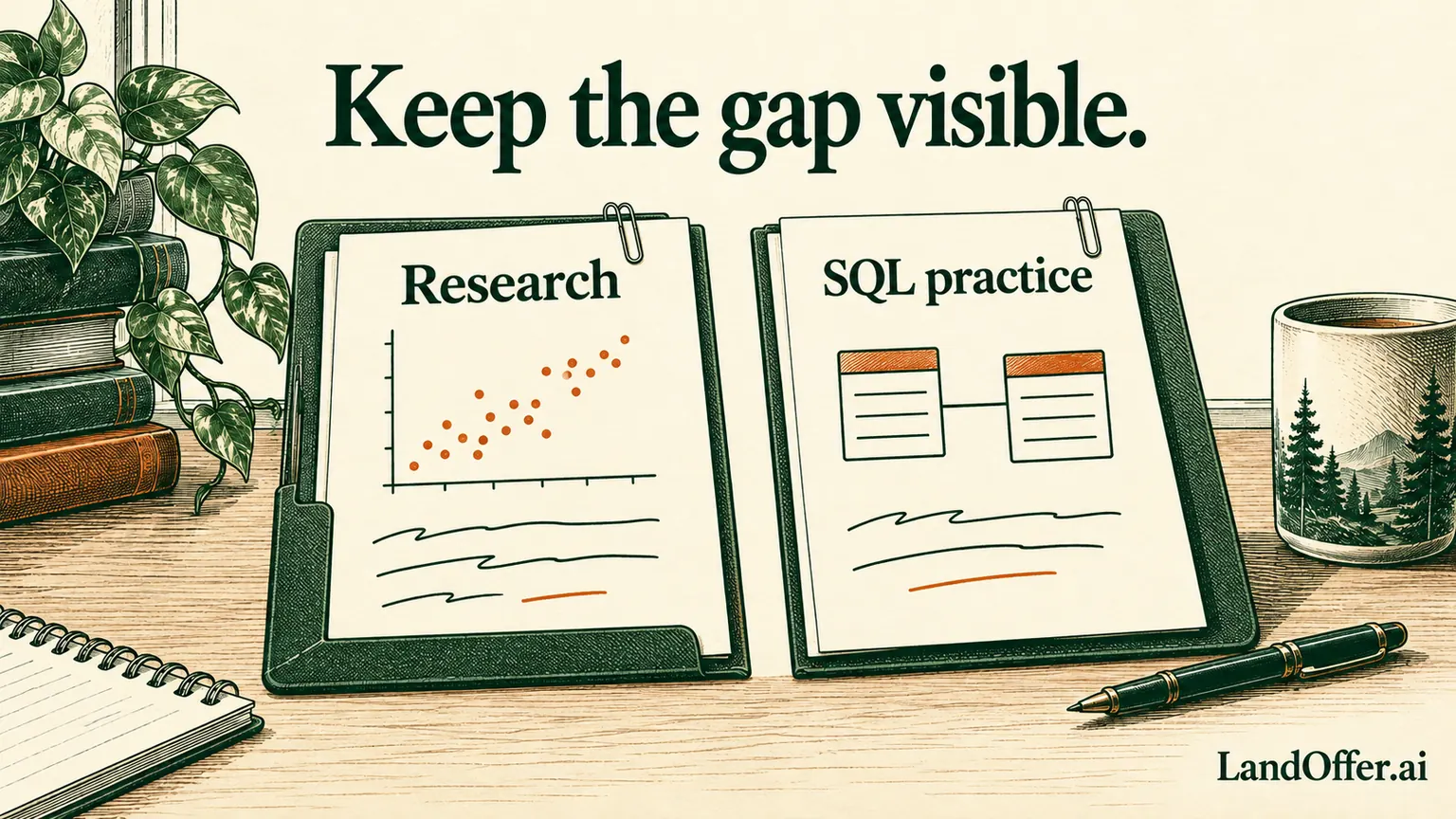
Priya cannot honestly add “SQL” to her research bullets because a job requires it. In the fictional case, she completes a separate practice project using a synthetic experiment database. Its purpose is to test whether she can express familiar data questions through a relational query, not manufacture professional SQL experience.
In the fictional completed project, she creates sample and measurement tables, writes a join that preserves samples with no measurements, and checks how duplicate measurement rows affect counts. Her README states that the data are synthetic and the work is independent practice. She compares the output with a hand-checked small fixture before describing it.
Her project entry becomes: “Independent SQL practice: queried a synthetic experiment dataset to identify samples with missing measurements; checked join behavior and duplicate-row counts against a hand-reviewed fixture.” It belongs under Projects, with the actual completion date, rather than inside the university job description.
The project narrows one gap. It does not establish readiness for every SQL-heavy analyst role, enterprise warehouse ownership or professional database administration. Priya can now show a limited query example and discuss its behavior; she still compares each posting's required depth with that evidence.
Arrange the resume around the chosen reader
Choose section order according to what establishes relevance. A current graduate student may place Education near the top to explain degree status and timing, then Research Experience, selected Projects and Skills. A candidate with substantial relevant industry work may lead with that experience instead. Use the employer's requested format and a layout you can read comfortably after export.
For Priya's analytics version, the education line says “PhD in Materials Science, expected May 2027.” It does not say “PhD, 2027” in a way that could imply completion. Her available start date appears consistently in the application response, and she updates the estimate if her research schedule changes.
Selected publications can earn space when they demonstrate relevant domain work or a method the role needs. Include enough attribution and status to be accurate: a manuscript under review is not an accepted publication. A compact selected entry or permitted link may be more useful than importing the full bibliography into an unrelated analytics resume.
Teaching also needs selection. If Priya explains analysis methods to lab students, that may support a role requiring stakeholder communication. Listing every course number will not explain that contribution. Describe the audience, responsibility and output you actually handled, while keeping teaching distinct from managing professional analysts.
Keep the skills section consistent with the evidence. Tools used once in a guided exercise should not silently appear as deep professional expertise. You can state the setting where useful and prepare an example for each prominent skill. If a listed skill lacks an example you can explain, remove it or describe the limited practice setting accurately.
Name each saved version for its audience and retain the source evidence bank. Priya’s analytics document and research-associate document may use different section order, but both retain the same degree status, dates and contribution boundaries. Before reusing either file, check its actual contents rather than relying on a filename. This keeps role-specific selection from becoming a gradual change to the underlying history.
Check degree timing and application consistency
Graduate transitions have dependencies that ordinary resume polishing cannot solve. Check the role's start date, enrollment or graduation window, required degree status and any stated work-eligibility conditions. A rolling industry role and a structured university recruiting program may have different timing requirements.
Answer those questions from your actual circumstances. If authorization or academic-program restrictions are uncertain, consult the appropriate university or qualified advisor rather than guessing from another student's experience. A resume can make your timeline clear; it cannot resolve eligibility by changing a label.
Before submitting, compare the resume with the form: degree in progress, expected date, research title, employment dates, project setting and selected skills. Imported fields may need correction even when the uploaded document is accurate. Keep the specific file version with the role record so later conversations refer to what the employer received.
Ask a reviewer outside your specialization to explain what you did from the excerpt alone. If they can only repeat the dissertation title, translate the action more clearly. If they infer that you shipped a product when you analyzed lab experiments, restore the setting and ownership boundary.
Choose one target family from recent roles on LandOffer.ai, complete a research-to-responsibility map, and produce one resume version whose title, degree timing and selected bullets match that evidence. Keep the full CV available for applications that actually request it.
Sources and Further Reading
- Princeton: Transforming Your CV to a Resume — retaining a master CV and selecting relevant material.
- MIT CAPD: PhD Resumes for Industry Jobs — CV/resume distinctions and industry-focused preparation.
- Harvard MCS: Resumes for Industry, Grad Student Edition (2026) — attributed panel advice on organizing and explaining graduate experience.