 LandOffer
Job search
How to Describe Personal Projects on a Resume When You Have Little Experience
Explain the independently changed behavior and checks; distinguish tutorial foundation from authorship.
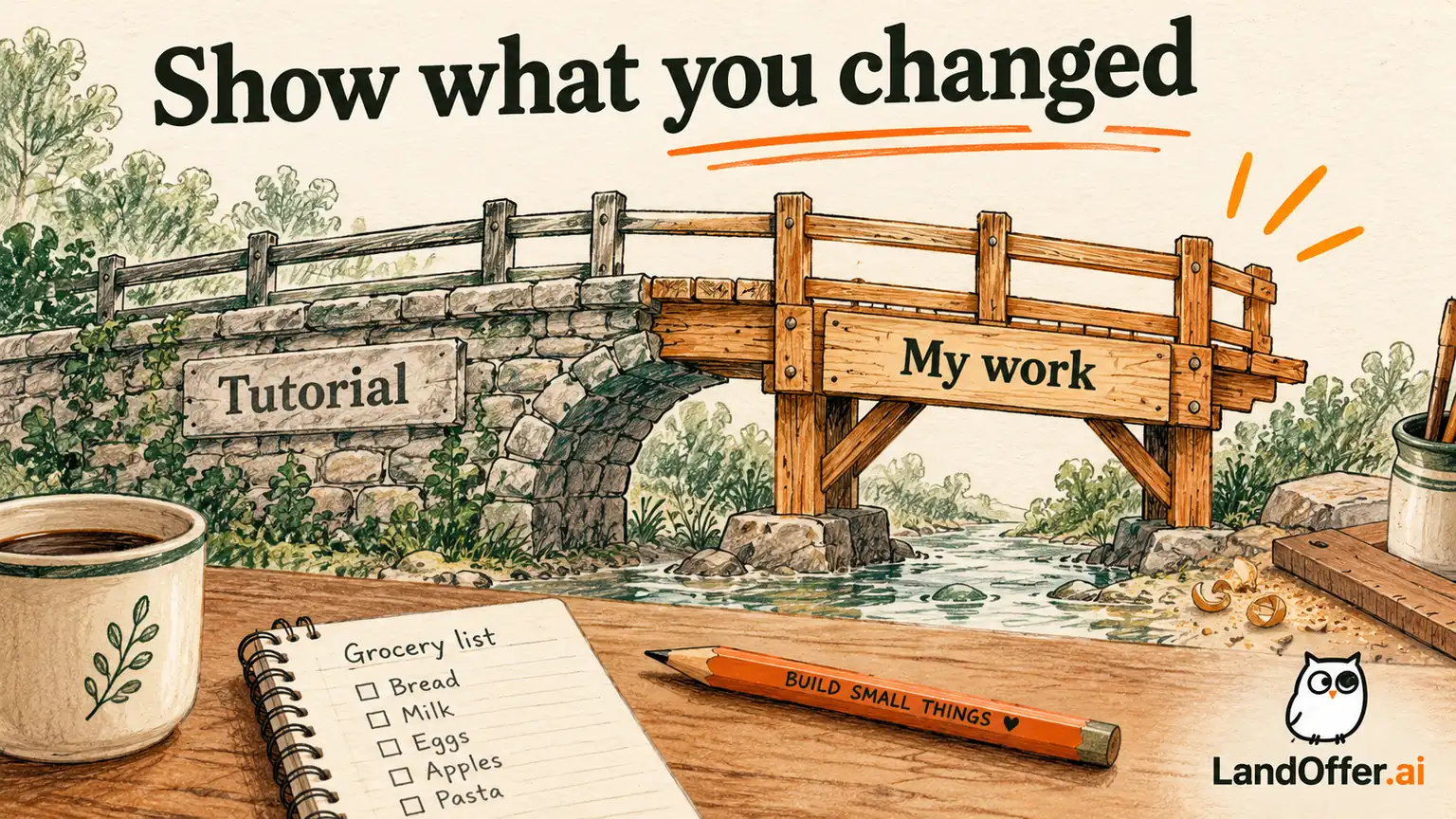
Describe a personal project through the problem you chose, the behavior you implemented, a meaningful trade-off and the checks you completed. Make your contribution distinct from a tutorial, library or teammate's work. A small local project can demonstrate useful engineering evidence without invented users, revenue, production scale or a claim that you built every component from scratch.
Find one relevant description through LandOffer's recent roles, then choose project evidence that addresses its work. LandOffer publishes this guide. Official writing and repository guidance was checked October 8, 2026. Rosa Ortiz, Pantry Queue and all project facts below are fictional teaching inputs, not a tested application or candidate testimonial.
Start with a problem that explains the choices
A project title and technology list do not tell the reader what you were trying to make work. “Grocery app using React” could describe a tutorial copy, a new interface, a collaboration system or a shopping-list experiment. Name the task before listing the tools.
Rosa's fictional problem is a shared household list where someone can mark an item obtained while another person is offline. She chooses a local prototype to investigate conflicting edits, not to launch a business. That problem creates a reason for the interface, storage behavior and tests.
Her notes distinguish who the prototype was designed for from anyone shown to have used it. “For household shopping” describes the purpose. “Used by 500 households” would require evidence that the project does not have. A useful project can show thoughtful design even when the only inputs are synthetic examples and the only readers are classmates.
Choose a scope you can explain. You do not need every feature a commercial product would have. A smaller task with a clear failure mode and a checked correction can provide more useful evidence than a broad clone whose behavior you cannot describe. Keep the unfinished parts visible in project documentation.
Separate the tutorial baseline from your changes
Pantry Queue begins with a fictional tutorial's basic list screen and CRUD routes. Rosa adapts it to explore a shared-list conflict. She did not author the initial component structure, tutorial styling or framework. Owning the repository would not change that authorship boundary.
GitHub's fork documentation describes a fork as a repository that begins as a copy of an upstream repository. That relationship is a useful reminder: the repository's location does not prove who wrote all its code. Preserve attribution and make your independent contribution explicit in the README and resume.
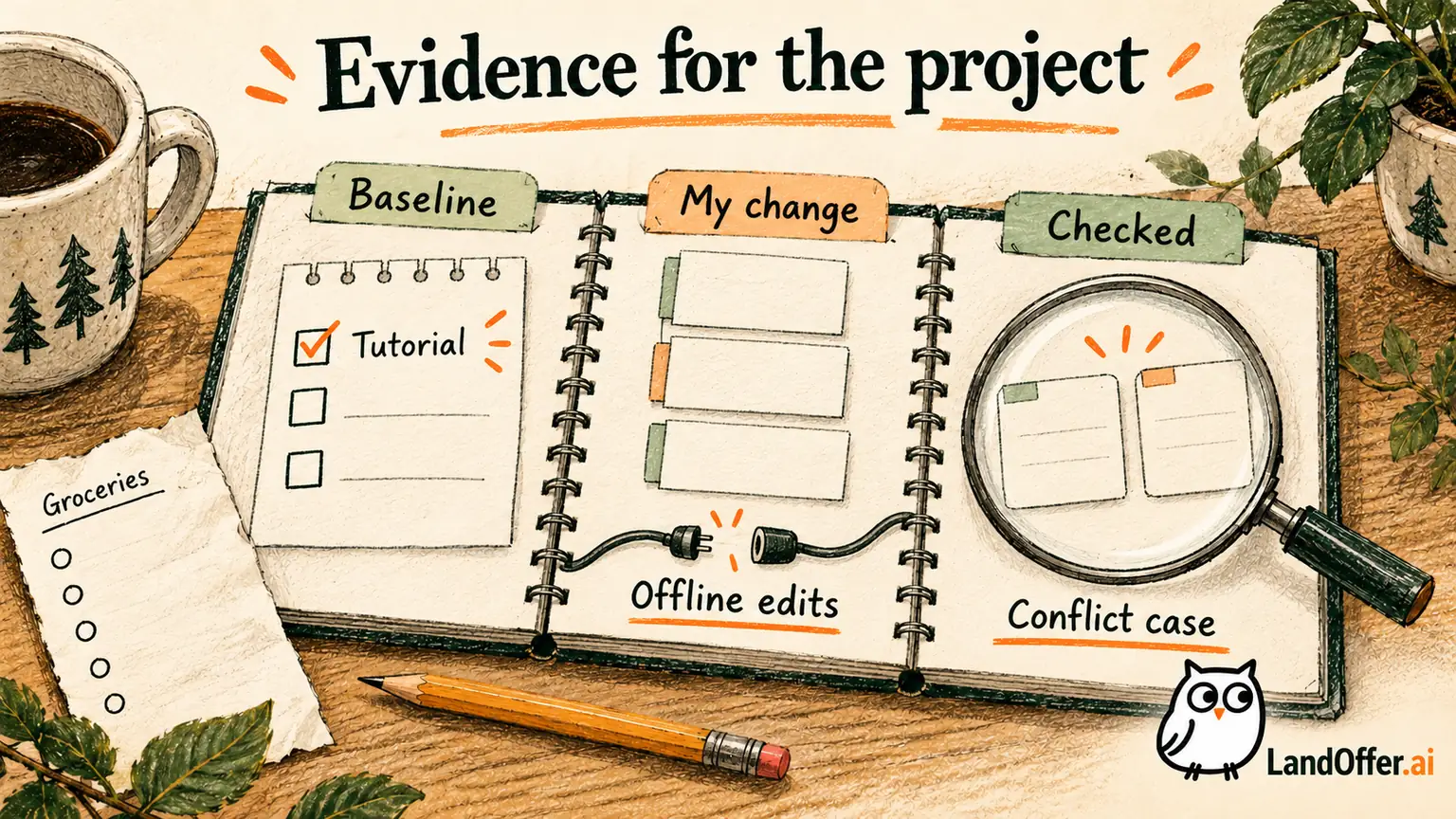
The completed contribution ledger is fictional but specific:
| Starting material | Rosa's independent change | Evidence input in this example | Resume boundary |
|---|---|---|---|
| Tutorial list screen and CRUD routes | None claimed for the baseline | Attributed tutorial reference in README | Do not say built the whole app from scratch |
| Tutorial allows immediate edits | Added pending-edit state for offline actions | Design note and implementation commits | Local prototype, not production synchronization |
| No conflict display in the baseline | Added a visible conflict notice after reconnect | Synthetic two-client replay notes | Checked sample behavior, no universal conflict guarantee |
| Tutorial tests cover basic creation | Added eight illustrative tests for edit conflicts and cancelled actions | Fictional test inventory | Test count is a teaching input, not a real run in this article |
| Hosted tutorial demo | Rosa runs her version locally | Local setup instructions | No hosted user adoption claimed |
The table resolves what belongs in the resume. Rosa can claim her pending-edit logic, conflict display and specified checks. She cannot claim the baseline as original work or present a local replay as a commercial deployment.
Turn the contribution ledger into usable bullets
Before:
Built a full-stack grocery platform with React and Node that improved household efficiency and supported real-time collaboration.
The sentence stretches several facts. “Platform” is broader than the local prototype. Household efficiency was not measured. Real-time collaboration may imply behavior the chosen offline experiment did not establish. It also omits the tutorial foundation.
After:
Extended an attributed React/Node tutorial into Pantry Queue, a local shared-list prototype, adding pending-edit state and a visible conflict notice for edits made while offline.
Defined eight tests for conflicting edits and cancelled actions, using synthetic two-client replays to inspect the prototype's reconnect behavior.
These are finished fictional resume bullets. They communicate what changed, why it mattered and the environment of the evidence. In a real resume, the second bullet should describe tests you actually wrote and ran, using the real count and method. This article has not executed the imaginary Pantry Queue test suite. The eight-case inventory is a fictional writing input; no test result is observed in this project example.
If attribution makes the sentence long, keep a concise reference in the project line and describe the independent changes in the bullets. Do not remove the origin just to produce a more impressive claim. “Extended a tutorial” can still show engineering judgment when the extension addresses a concrete problem.
Explain one decision that changed behavior
Rosa initially considers silently overwriting the earlier item state after reconnect. She rejects that approach because it would hide disagreement between the offline edits. For this prototype, she chooses a visible conflict notice and asks the user to select the intended state.
That choice is not necessarily the best design for every shared-list application. It is a defensible response to this fictional project's scope. It prioritizes visible disagreement over automatic resolution. Rosa can explain what she gained, what friction she introduced and what another design might require.
The resume does not need the whole design argument. “Added a visible conflict notice rather than silently overwriting offline edits” communicates the relevant trade-off. The README can retain the rejected alternative and the reason for the chosen behavior, so the short resume sentence remains explainable, including why automatic merging was out of scope and what would be needed for a broader implementation.
Technical names help when they explain the work. Listing React and Node identifies the environment; naming the pending-edit state explains the behavior. A list of every package in the dependency file would make the reader do the work of identifying which part Rosa understood and changed.
Show verification as a completed activity
Describe the checks you actually performed: unit tests, a manual scenario, a reproducible defect, a synthetic fixture or a comparison against an expected result. Say what the check establishes. A working screenshot can feel like the project is finished; the reconnect and conflict checks show which behavior Rosa can actually describe.
In Rosa's fictional case, the replay notes include two clients editing the same item, a cancelled pending action and a reconnect after no changes. Her expected outcomes are written before inspecting the implementation. That helps distinguish a checked result from accepting whatever the program happened to display.
Do not translate a handful of checks into total reliability. “Checked the three documented replay scenarios” preserves scope. “Eliminated synchronization bugs” would require much broader evidence. If you discover an unresolved case, record it and decide whether the resume wording needs narrowing.
MIT's writing guidance connects an activity to its context and result. The result need not be a percentage. A reproduced problem, a visible correction or a checked behavior can describe engineering work when it is specific and true.
Complete a README evidence excerpt
The following is a finished fictional excerpt Rosa could use. It demonstrates how the project record supports the resume; it is not a claim that this repository exists publicly.
Pantry Queue — local prototype. Started from an attributed list-app tutorial. My changes are pending-edit state, a reconnect conflict notice and synthetic replay checks. The tutorial's initial screen, routes and styling are baseline material.
Decision. Conflicting offline edits remain visible for user resolution instead of silently overwriting the earlier state. Automatic merging and production multi-user operation are outside this prototype's scope.
Checks. The example test inventory contains eight cases across conflicting edits and cancelled actions. Replay notes cover two clients editing one item, cancellation before reconnect and reconnect without changes. Real project documentation would include the commands and recorded outcomes.
Known limit. The prototype uses synthetic data and local execution. No household adoption, production availability or time-saving result has been measured.
This excerpt gives the reader a route from the bullet to the implementation decision and its limits. It also explains what a future project improvement would mean. Adding a feature later should update both the documentation and the resume rather than silently expanding the older claim.
An unresolved failure can also guide the content choice. Suppose Rosa's fictional replay reveals a duplicate notice after reconnect and she has not corrected it. She should not describe conflict handling as complete. She can either fix and recheck that case or narrow the entry to the pending-edit state she has established. You can still describe the established work when one behavior remains unresolved; the wording simply needs to match the current evidence. In a real record, preserve the failure notes and the later correction instead of reporting only the attractive final screenshot.
Choose projects by evidence, not novelty alone
Rosa has three possible projects for an application-service role. Pantry Queue has independent behavior changes and documented checks. A weather dashboard follows a tutorial with only color changes. A command-line reading-list utility is small but includes original search behavior and error handling.
She selects Pantry Queue for offline-state decisions and the reading-list utility for search and error handling. She removes the weather dashboard from this resume because it adds little independent engineering evidence for the target role. That is a completed content decision, not a judgment that tutorials are a poor way to learn.
For another role, the choice can change. If Rosa develops an independently designed accessible dashboard, it may become useful frontend evidence. The project earns space through the work she can explain at that time. A fashionable stack or an elaborate title should not substitute for a contribution record.
Two carefully described projects can be enough for the selected page. The number is not a quota. Preserve other projects in the portfolio when useful, but avoid crowding the resume with several entries that all demonstrate the same basic tutorial task.
Preserve ownership in team and open-source work
If a project is shared, name your component and collaborators' boundaries. “Implemented the conflict notice in a three-person project” can be accurate when another person built storage and a third built deployment. “Built the system” would imply more unless your role really covered that scope.
For open-source work, distinguish submitted from merged, and merged from deployed or adopted. A pull request can demonstrate a contribution without proving production use. Keep the public artifact available when appropriate, but do not disclose private review material or credentials as evidence.
Harvard's resume guidance emphasizes factual, specific language. Apply that standard to every tool-assisted rewrite. Reject additions about scale, users, speed or ownership that your project record cannot support. Clearer wording should expose your contribution, not make it larger.
Finish with a project the reader can investigate
Rosa's final entry identifies the tutorial starting point, her offline-edit extension, the chosen conflict behavior and the bounded checks. Her second project demonstrates a different application-service behavior. She leaves out the lightly changed dashboard and every unsupported commercial result.
Choose one role from LandOffer's recent jobs, then write a contribution ledger for your strongest project. Turn two supported rows into bullets and make the README explain the decision and checks. When a claim lacks evidence, narrow the wording or complete the work before using it. Browsing the target role and drafting the ledger do not publish a repository or submit an application.
Sources and Further Reading
- GitHub: Forks: upstream-copy relationship and repository boundaries.
- MIT CAPD: Writing about skills: activity, context and result in resume evidence.
- Harvard MCS: Strong resume guidance: specific factual language and authentic editing.