 LandOffer
Job search
Applying to Multiple Jobs at One Company: How to Keep Your Applications Coherent
Choose roles around a shared work account, then tailor emphasis while preserving factual history.

Apply to multiple jobs at one company when each role has a clear connection to work you can explain, and keep employment, education and contribution facts consistent across applications. Check that employer's current application limits first. Then select related responsibilities, tailor the evidence you emphasize, and preserve separate records for the openings you actually pursue.
You can browse recent roles on LandOffer.ai to compare duties before choosing a company queue. LandOffer publishes this guide and offers job-search tools. It uses official process descriptions checked October 8, 2026, and a fictional four-role selection. It supplies a coherence method, not a universal number of applications or a claim that a recruiter will react favorably to a particular combination.
Check the employer's rule before selecting a number
Different employers publish different limits. Google Careers help allows up to three jobs in a rolling 30-day window. IBM's application FAQ says candidates may apply to as many roles as they like, completing each individual application separately. Those are company-specific rules, not two competing industry standards.
Check the current employer page and the account's relevant application history. “Three this month” may not mean a rolling 30-day window. A calendar reset in your tracker does not reset the employer's rule. Keep dates accurate and do not use another account to work around a published restriction.
Even where a policy permits many applications, select jobs from duties you can support. You still need evidence for each opening and time to review its material. Conversely, a limit below the number of interesting roles requires prioritization. It does not require pretending that all of them are equally relevant.
Save the source and checked date with your decision. If no quantity rule is published, record that you found no stated cap on the page checked. Do not turn that limited observation into “unlimited applications are accepted everywhere.”
Define the work account that connects your choices
Write a short account of the responsibilities you can support today. Include the setting, tools, decisions, collaboration and operating duties. Use that account to identify related role families. A shared word such as “engineer” is much weaker than a shared need for API contracts, compatibility checks or service investigation.
Fictional engineer Darius Khan works at invented Meridian Quay as a Software Engineer. His stated fictional history runs March 2023–Present. He implements Java service endpoints, documents versioned API contracts, writes compatibility checks and investigates integration failures with a support colleague. A platform team owns deployment infrastructure. Darius has not trained production machine-learning models or run a public developer community.
This account can support more than one role without becoming four different professional identities. Backend service work and integration engineering may value different parts of the same record. A machine-learning leadership job requires evidence the record does not contain. Internal documentation is not automatically public developer advocacy.
Keep the original employment title. “Integration-focused experience” can describe relevant work; renaming his previous job to match every target would change history. The applications should agree about what happened even when the opening paragraphs differ.
A completed four-role selection
Darius reviews four fictional Asterbay openings. The company, requisitions, duties, settings and decisions below are invented teaching inputs. They are not public vacancies or observations of a recruiting team's preferences. The fictional employer instructions permit separate applications and state no quantity cap on the page used in the example.
| Fictional role | Main work requested | Evidence Darius can supply | Decision |
|---|---|---|---|
| AB-615, Backend Engineer, Dallas hybrid | Java APIs, contract changes and service investigation | Endpoint implementation, version notes and compatibility checks | Retain as first review target |
| AB-628, Integration Engineer, remote US with Dallas visits | Versioned interfaces, partner issue reproduction and coordination | Contract documentation and investigation with support colleague | Retain as second related target |
| AB-690, Machine Learning Lead | Model training, evaluation and leadership of a production ML team | No model or ML leadership work in the stated record | Defer; do not add ML claims |
| AB-703, Developer Relations Engineer | Public technical teaching and community program ownership | Internal documentation only; no public program evidence | Defer pending substantially different evidence |
Darius chooses AB-615 and AB-628. His fictional attendance constraint permits Dallas hybrid work and Dallas visits. He retains that constraint in both applications rather than selecting every location to broaden the queue.
The result is a finished selection that assigns review time to AB-615 and AB-628 and leaves the two unsupported tracks outside the queue. Two related roles remain because their duties connect to the same factual work, not because two is universally the right count. The deferred roles have named gaps. Darius keeps them out of this application block instead of preparing four resumes with unsupported skills.
Tailor emphasis while retaining factual invariants
Start from one reviewed work record. Mark which facts must agree everywhere: employer, original title, employment dates, degree, contact information and actual contributions. Also retain truthful answers about work authorization, attendance and other candidate-supplied facts. A different job should not produce a different history.
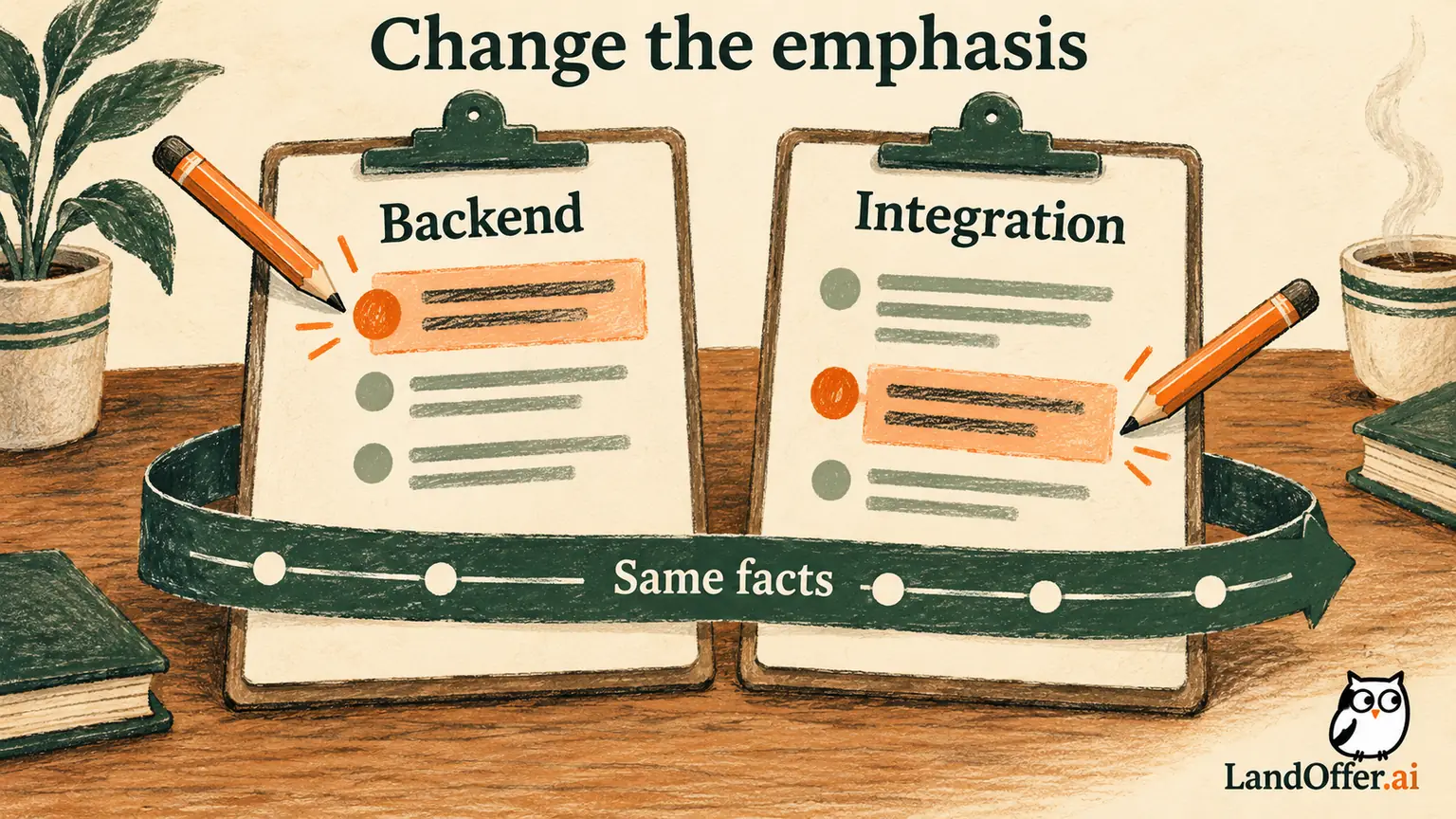
Then choose the most relevant supported evidence for each role. For AB-615, Darius leads with Java endpoint implementation and service investigation. AB-628 may lead with contract documentation and reproduced interface failures. Both can refer to the same project while making different aspects easier to assess.
CareerOneStop's application guide recommends recording positions applied for and employers contacted. Use separate requisition records beneath the shared company, with the selected filename and checked requirements. That keeps tailoring choices observable rather than hidden in a folder of similarly named PDFs.
Do not copy a target requirement into the skills section merely because it makes the two resumes look more coherent. Shared factual accuracy is the foundation. Unsupported Kubernetes administration in both files would be consistently wrong, not a coherent account of Darius's experience.
Two finished introductions for the selected roles
The following complete snippets use only the stated fictional work record. They are sample application introductions, not claims about Darius's real employment or messages sent to Asterbay.
For AB-615:
I am interested in the Backend Engineer opening because it centers on Java service interfaces and careful contract changes. At Meridian Quay, I implement service endpoints, write compatibility checks and investigate integration failures with a support colleague. I would bring that implementation and investigation experience to the responsibilities described in AB-615.
For AB-628:
I am interested in the Integration Engineer opening because it emphasizes versioned interfaces and clear issue reproduction. My Software Engineer work at Meridian Quay includes documenting API contracts, writing compatibility checks and investigating failures with a support colleague. That combination is relevant to AB-628's interface and coordination responsibilities.
Within the fictional history, the introductions differ in emphasis but agree on Meridian Quay, Software Engineer and the stated work; no application was sent here. Neither claims platform infrastructure ownership, ML expertise or public community leadership. The second does not inflate support collaboration into sole responsibility for every partner integration.
Once the introduction is clear, review the remaining application one question at a time. Read the custom questions and answer their actual prompt. If a form asks why this particular role, name its duties. A generic “I would accept any job here” does not explain the selected responsibilities.
Resolve differences that a shared profile cannot answer
A company profile can reuse contact or employment information while each application asks different questions. Inspect the new opening's fields, requested documents and role-specific statements. Do not assume previously entered answers remain appropriate merely because the company is the same.
In the fictional case, AB-615 asks about Dallas hybrid attendance, while AB-628 asks about travel to Dallas. Darius reads both and answers from the same actual availability. He does not paste an affirmative answer without checking what it means. His record stores the exact constraint and each question's scope.
A reused resume may also carry the wrong emphasis or old filename. Compare the selected file with the requisition before the final submission. Keep the Java service version associated with AB-615 and the interface-focused version with AB-628 in the private ledger.
If the system offers to apply profile changes to existing applications, read its explanation. Do not assume that replacing the profile resume updates every historical attachment. Keep prior submissions intact in your history and record any application-specific update separately.
A recruiter conversation should preserve the common reason
If a recruiter asks about your interest in several roles, explain the shared responsibility and your priority. You do not need to pretend the titles are identical or invent a plan to become all of them simultaneously. Name why each selected opening fits and what distinguishes them.
If Darius later submits both reviewed applications, his complete fictional response could be:
AB-615 is my first preference because my recent work is closest to implementing and investigating Java service interfaces. I also applied to AB-628 because API contract documentation and compatibility investigation are substantial parts of that work. I am interested in both sets of duties, with backend implementation as the stronger current match.
That response gives a preference without withdrawing the second application or claiming an employer decision. If a recruiter suggests another opening, Darius still reviews its requirements. A suggestion can be useful information while leaving a location, experience or technical-depth gap unresolved.
Keep the conversation tied to the exact roles and current materials. A recruiter may manage only one team or process. Do not assume that telling one contact your preference changes every application state in the company's system. Save the message and any explicit next instruction.
Avoid divergent versions of your background
Use a short consistency review before another application at the company. Compare headings, dates, employment status and the source facts behind the emphasized bullets. A legitimate tailoring choice changes prominence or phrasing. It does not change project completion, ownership or qualifications.
Darius's completed consistency note retains March 2023–Present, Software Engineer and Meridian Quay in both versions. The backend version moves Java endpoint work first. The integration version moves contract documentation first. Both keep platform deployment ownership with the platform team. Neither adds a model-training entry or public developer program.
That note is a finished decision record rather than a promise to compare later. It identifies what is retained and what is deliberately changed. The exact dates come from the fictional history; readers need their own verified chronology.
If a discrepancy appears, repair it before the next submission. For a previously sent inaccurate fact, inspect the employer's permitted correction route. Do not hide the inconsistency by editing your personal tracker to make all versions look the same retrospectively.
Darius also reviews what each introduction leaves out. The backend opening does not require him to call himself an integration lead, and the integration opening does not require claiming deployment ownership. The same omission can be appropriate in both versions because it reflects a factual boundary, not a lack of enthusiasm.
If he later completes a new responsibility, he can update the underlying work record and decide where it belongs. That new evidence would have its own setting and date. It should not silently appear as something he had already done in an earlier submitted file. Maintaining the common source record lets future tailoring change with the work while preserving past application history.
Maintain a company queue you can explain
After applying, keep one company overview linked to separate role records. Store the requisition, current state, selected file, receipt and next action for each. A rejection for one role does not automatically establish the outcome of another unless the employer says so. A recruiter conversation should be recorded at the scope it actually covers.
Review new openings against the same work account. A title closer to your interests can still require missing operating duties. A role with a different name may fit the evidence well. Recheck published limits when planning additional applications, especially if the rule uses a rolling period.
Choose a small set because you can explain and review it, with the employer's rule governing any numerical restriction. Use recent roles on LandOffer.ai to find one company and compare its roles. Retain the openings whose duties you can support, write one factual core, and record the evidence emphasized in each application. Keep the role-specific evidence notes with the common factual record. Review the selected attachments before submitting; coherent choices do not promise a hiring result.
Sources and Further Reading
- Google Careers applying help: company-specific rolling application limit.
- IBM application FAQ: separate applications and published quantity policy.
- CareerOneStop apply-for-jobs guide: record applications and employer contacts.