 LandOffer
Job search
Machine Learning Engineer Resume: Connect Models to Production Work
Connect model development to the production responsibilities you actually held. Use concrete records to explain deployment, evaluation, monitoring and the limits of your contribution.

A machine learning engineer resume should show how you helped turn a model into a system people could operate. Connect the model's purpose and evaluation to data contracts, deployment constraints, monitoring, and your own responsibility. An offline score can support that account, but it cannot establish production reliability or business value on its own.
LandOffer publishes this guide and offers job-search tools. Start with the work the role actually asks you to own. You can browse recent roles on LandOffer.ai, then compare their deployment and operating requirements with records from your projects. This guide uses public technical documentation and an explicitly fictional release dossier. It does not report an employer's scoring formula or a hiring outcome.
Read the role as a responsibility map
Two openings with the same title can ask for different work. One team may need online inference with a latency budget; another may need scheduled batch predictions with reliable data delivery. A research-heavy opening may value experiment design, while a platform opening may emphasize packaging, reproducibility, and operations. The title alone cannot tell you which experience belongs near the top.
Make a short map from each substantial requirement to something you actually did. For “deploy models,” identify the environment, release mechanism, tests, and your contribution. For “monitor performance,” distinguish service health from model quality. For “maintain pipelines,” explain which inputs, transformations, schedules, and failure cases you controlled. The map connects a requirement to work you can explain and verify.
The Google Cloud MLOps architecture guidance is useful technical background: model code sits inside a larger system of data verification, serving, testing, and monitoring. That description supports separating responsibilities. It does not require every candidate to have operated every component or every employer to use Google's architecture.
If a requirement has no corresponding record, leave it as a gap. Familiarity with a framework is different from maintaining a service built with it. You can still describe a relevant experiment or personal project, provided its setting and operating limits are clear.
Build the evidence before writing the bullet
The following fictional example concerns Iman Fenwick, an ML engineer at the invented Mossline Freight. Iman worked on a nightly anomaly-triage system that flagged shipment records for human review. The example is an original teaching case, not professional experience readers should copy. Its assumed records provide the foundation for every detail below.
The release dossier contains a design note describing a nightly batch job, a versioned feature schema, a container build, a staging run log, a rollback instruction, and a shared responsibility note. The team had delayed labels: reviewers confirmed anomalies after the nightly run. The dossier contains no revenue study, no online experiment, and no claim that the system prevented a particular number of shipment failures. These records establish staging validation and a reviewed handoff; they do not establish production operation.
Iman wrote the packaging and schema-validation changes, added alerts for missing inputs and failed runs, and documented how to restore the previous model artifact. A data engineer owned upstream ingestion. An operations specialist decided how to use the review queue. A colleague selected the original model. Those boundaries matter because “owned the ML system” would conceal work done by other people.
| Responsibility | Fictional record that supports it | Resume boundary |
|---|---|---|
| Deployment | Container build and staging release note | Packaged and validated the batch job in staging; did not claim live operation |
| Data checks | Schema contract and rejected-input log | Validated expected fields before prediction; upstream collection remained with another team |
| Monitoring | Failed-run alert and missing-input alert | Monitored pipeline health; delayed labels limited immediate quality measurement |
| Recovery | Previous-artifact restoration instructions | Documented rollback; did not claim every failure was automatically resolved |
| Collaboration | Responsibility note signed off by the project team | Coordinated a release with data and operations colleagues |
This completed map answers a practical question: what can Iman defend if asked to explain the work? “Python, Docker, and ML” names tools. The map identifies the part of the system those tools helped change and the evidence available to support the statement.
Rewrite notebook work into an accurate operating account
Iman's first draft says:
Built a machine learning model using Python and Docker to improve shipping operations.
It combines model development, packaging, and a business outcome that the dossier does not establish. The stronger version should not solve that problem by adding an invented percentage. It should match the work to the records:
Packaged the shipment anomaly model as a nightly batch job, added schema and failed-run checks, and documented restoration of the previous artifact for operations handoff.
The rewrite shows deployment, a failure boundary, and a recovery task. It also removes a model-authorship claim Iman cannot support. The fictional release and responsibility notes support a reviewed operating handoff; they do not establish an improvement in shipping performance. The revised bullet gives a precise account of operating work.
A second bullet can cover the monitoring limitation:
Added missing-input and job-failure alerts for the prediction pipeline; coordinated delayed-label review with operations to separate pipeline health from model-quality follow-up.
That statement describes work completed in the fictional dossier. It does not claim live quality was continuously observable. The distinction gives a reader a better sense of Iman's judgment than a broad “implemented monitoring” claim would.
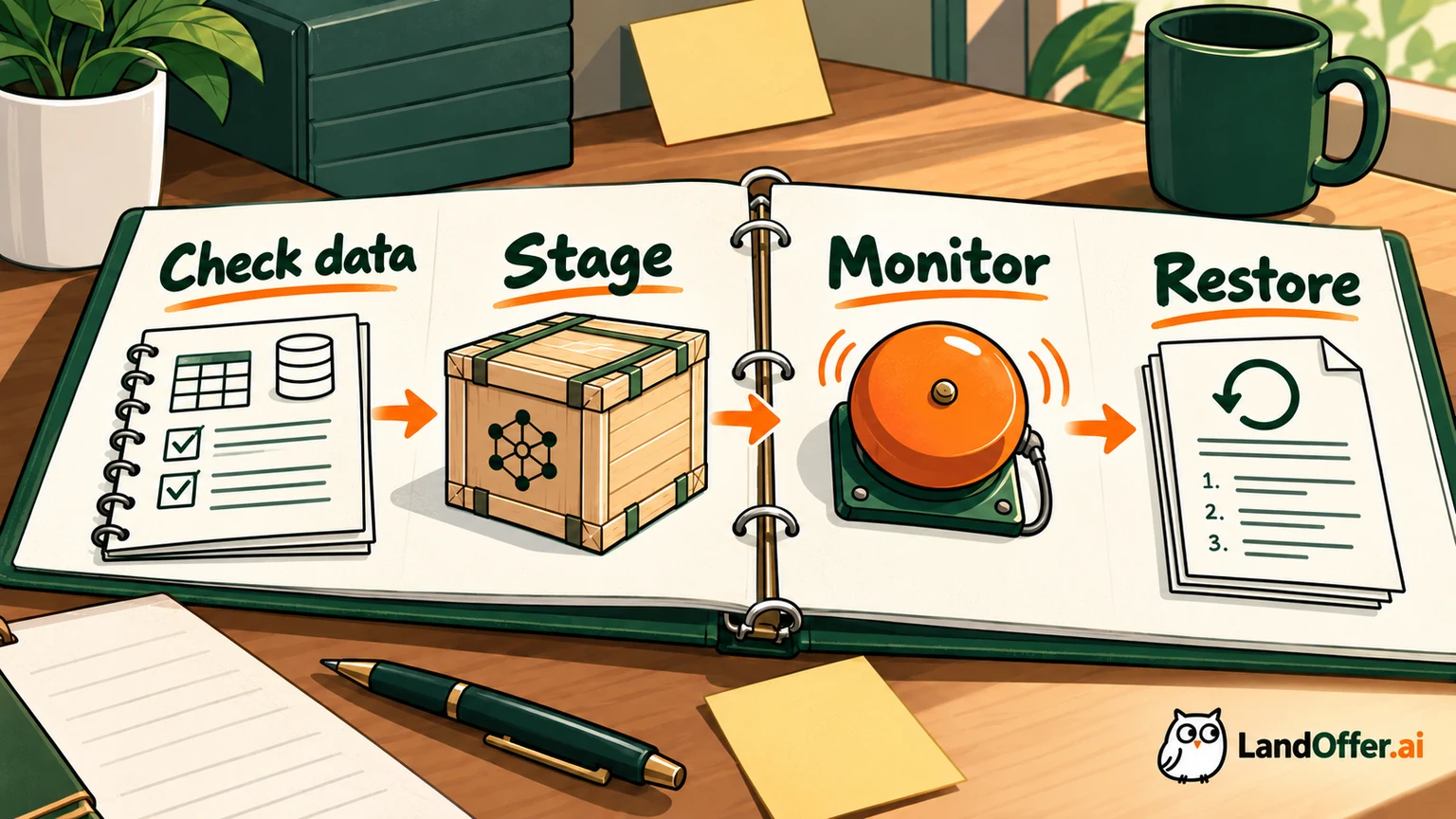
Keep the two bullets separate only if both address important requirements in the target role. If space is tight, combine the operational checks with the deployment bullet and save the delayed-label discussion for an interview. Do not let the desire for a compact document erase the setting that makes the claim accurate.
Explain the model metric without making it carry the whole story
An offline result needs context: the prediction task, the evaluation population, the comparison, and the metric. A score without those details can look precise while telling the reader little. Classification accuracy may be unhelpful for a rare event; a retrieval metric may matter only at a particular review capacity. Use the measure your project actually used and be ready to explain its limits.
The scikit-learn common-pitfalls documentation discusses consistent preprocessing and data leakage. These are technical reasons to ask how the evaluation was produced. They are not instructions to add an “ATS-friendly” model score to your resume.
For your own work, recover the evaluation script or report before quoting a result. Determine whether preprocessing was fitted only on training data, whether the split matched the intended use, and whether tuning touched the final evaluation set. If you cannot reconstruct the comparison, a bounded description of the evaluation task is better than a number whose meaning you cannot defend.
In Iman's case, the dossier records an evaluation report created by the modeling colleague. Iman can mention integrating the approved artifact, but cannot take credit for an improvement in model performance. An engineer who did improve the model should identify that work separately from deploying it.
Avoid squeezing every caveat into one bullet. Keep an internal evidence note with the full split and metric definition. The resume can carry the most relevant context; an interview can carry the methodological detail. The shorter public statement must still remain true without the hidden note.
Distinguish monitoring signals and data responsibility
“Monitored the model” can refer to several different activities. A job can finish successfully while its predictions become less useful. A service can return quickly while receiving inputs unlike its training data. An alert can detect missing columns without detecting mislabeled examples. Name the signal you collected rather than using monitoring as a blanket claim.
A resume might describe service errors, input distributions, prediction distributions, or measured quality once labels arrive. Choose only the signals you implemented or investigated. A dashboard someone else built can be part of your collaboration, but viewing it does not establish that you designed the monitoring system.
Data responsibility is similarly specific. Did you define an input schema, investigate a join error, maintain feature transformations, or agree on a label process? Did you own the data source, or consume it under a contract? These distinctions matter because repair authority can sit with another team.
In the fictional example, Iman's missing-input alert directs the data engineer to inspect upstream delivery. The fallback instruction protects the batch job while the issue is investigated. The operations specialist owns the human-review process. That dependency is the point of the collaboration, not a weakness to disguise.
Write about an incident only if you can support your part. “Investigated a prediction drop after an input change and coordinated a schema repair” can be credible without claiming a quantified loss was prevented. Service logs, a change review, or a corrected contract can establish the contribution when outcome attribution remains uncertain.
Show the technical choice, not every library
A skills section helps readers locate relevant technologies; a decision explains why your experience fits the system they need to operate. Pair a tool with its purpose where that purpose distinguishes your work. A container may make an artifact reproducible; a queue may decouple batch input from processing; a versioned schema may expose an incompatible change before inference.
Explain an alternative you rejected when it reveals useful judgment. Perhaps the team chose batch predictions because labels and downstream actions arrived on a daily schedule. Perhaps a smaller model met resource constraints and was easier to operate. These are examples of possible reasoning, not conclusions about what every ML team should do.
For Iman's deployment-focused role, keep Docker beside the reproducible release task and the schema check beside its rejected-input boundary. Include libraries you used meaningfully and can discuss. Remove tools copied from the target posting if your only exposure was reading their names. A learning project can demonstrate new practice, but it needs its own honest label.
For LLM work, apply the same standard. Describe the workflow, evaluation inputs, retrieval or tool boundary, and failure handling you actually built. Do not relabel a prompt experiment as a production agent service. A deployed prototype is still a prototype when users, reliability requirements, or operating duration were limited.
If your experience stops before production
You do not need to invent an on-call history to write a useful resume. State the environment you reached and the checks you completed. A local container, reproducible training pipeline, staging deployment, or benchmark harness can demonstrate engineering work. It cannot establish live reliability or end-user adoption.
For example, a personal-project bullet could say that you packaged a classifier, tested schema rejection on synthetic malformed inputs, and wrote a reproducible startup guide. If you never operated it for others, omit “production” and “served users.” Describe what someone can inspect: repository changes, test outputs, or an accompanying technical note.
An honest project label lets you discuss the work confidently when someone asks who used the system. The goal is not to make smaller work sound large. It is to make the real work easy to understand and verify.
Use Harvard's resume guidance as a writing reference for specific, fact-based descriptions. Your project records supply the facts; a career guide cannot supply them for you.
Choose the evidence for one target role
Read the requirements again and select the examples that cover its main responsibilities. For a deployment-focused opening, Iman's packaging, schema gate, and recovery handoff deserve prominence. For a modeling-focused opening, that same experience may need a separate example showing actual modeling work. Changing the order does not change the facts.
Check each bullet against three questions: what changed, what was mine, and what record supports it? Remove a metric if its comparison is unclear. Narrow ownership if a colleague supplied a major component. Keep the operating constraint when it explains why the engineering decision mattered.
Your resume can then describe the engineering work and environment you can support in a technical conversation. Browse recent roles on LandOffer.ai, choose one deployment or monitoring requirement, open a release note or test record from your own work, and rewrite one bullet from that evidence.
Sources and Further Reading
- Google Cloud MLOps architecture: technical context for validation, serving and operations.
- scikit-learn common pitfalls: preprocessing consistency and leakage.
- Harvard resume guidance: specific, fact-based resume writing.
Evidence checked October 8, 2026. Iman and Mossline Freight are fictional; the example describes assumed records, not a verified professional achievement.