 LandOffer
Job search
How to Organize a Job Search While Working Full Time
Plan a job search around the time and confidentiality constraints of full-time work. A worked schedule shows how to keep research, application reviews and follow-ups manageable when the week changes.

A job search alongside full-time work becomes easier to manage when each calendar block has a specific task and an honest stopping state. Reading a posting, updating an evidence paragraph, reviewing a form, and submitting an application are different activities. A busy week may leave useful preparation finished while the application itself remains a draft.
This guide combines public career-planning guidance with an entirely fictional employed candidate's schedule. The calendar, employer, work examples, and minutes are teaching assumptions, not measured productivity benchmarks. To choose a role for your own reading block, browse recently posted jobs on LandOffer. LandOffer publishes this guide and benefits from readers using its job search; a listing does not create more time or establish your fit.
Give each block a task you can finish
Start with the time you can actually reserve outside your current work commitments. Consider interviews, travel, care responsibilities, and rest before treating an empty-looking calendar as usable capacity. A short block can support a bounded task, but it may be a poor place to begin a long form whose later questions you have not yet seen.
The CUNY Queensborough Community College job-search planning guide supports organizing tasks, maintaining records, using a calendar, and periodically reviewing the plan. The UK government's JobHelp planning guidance likewise encourages realistic targets, time allocation, and breaks. These are public planning principles, not a prescribed application count or a rule for your employment situation.
A useful task has an input, an action, and a stopping point. “Job search” has none of those. “Read the service-ownership duties in this posting and record unresolved on-call questions” does. “Improve resume” can expand indefinitely. “Replace one vague project paragraph with a supported description and save a named draft” has a visible end.
Name the posting or draft to open, the task to perform, and the state to record when the block ends. This also lets you stop without losing your place. The next session should begin from a written state, rather than from a browser full of tabs whose purpose you have to reconstruct.
A completed three-block personal schedule
Linus Hart is a fictional software engineer at the invented Aster Pond Lab. In this example, he maintains a test helper under team review. His personal accomplishment note describes that bounded contribution without copying source code, internal tickets, customer information, or unreleased product details. It does not turn a reviewed helper change into ownership of the team's whole delivery system.
Linus assumes he can reserve two 45-minute personal blocks and one 60-minute block during a modeled week. That is 150 minutes altogether. The budget allocates 20 minutes to reading, 30 to updating material, 45 to form review, 10 to recording the state, and 45 to buffer time. The arithmetic is an authored example, not a claim that these tasks take the same time for everyone.
Here is his finished task schedule, prepared before beginning that week.
| Personal block | Assigned work | Stopping point | Minutes reserved |
|---|---|---|---|
| Tuesday | Read one posting; revise the first part of a supported experience paragraph | Duty note saved; material remains a draft | 20 reading + 25 material = 45 |
| Thursday | Finish the paragraph; record the selected file and unresolved questions; leave buffer | Named document saved and state record updated | 5 material + 10 record + 30 buffer = 45 |
| Saturday | Review a prepared application draft; leave correction buffer | Review result recorded before any submission decision | 45 review + 15 buffer = 60 |
The task totals also reconcile: 20 + 30 + 45 + 10 + 45 = 150. Buffer is a reservation, not an achievement. A block with unused buffer does not count as extra completed work, and the schedule does not imply that the form has been submitted.
The completed schedule assigns tasks within Linus's assumed personal calendar. His first two blocks can produce a useful duty note, a bounded experience paragraph, and an accurate file record. The longer block has a separate purpose: inspecting what the application will actually contain before considering the final action.
Keep your work evidence usable without taking work records
The University of Michigan's resume resources emphasize checking accuracy and preserving your own voice when using AI, and flag sensitive employer information and nondisclosure considerations. That supports a careful evidence boundary. It does not establish permission to copy a particular internal document or interpret your agreement for you.
Use personal notes about your responsibilities and contributions where you are permitted to keep them. A useful note might describe the problem, your own action, who reviewed or approved it, and the limits of the result. It need not reproduce the underlying company artifact. Do not move internal code, screenshots, customer records, access details, or confidential metrics into a personal portfolio because they would make the story more concrete.
Linus's completed paragraph says: “Maintained a test helper for a team workflow, reproduced a failing case, and documented the change for colleague review.” All of that is fictional. The wording identifies his contribution and review boundary; it adds no numerical outcome, internal implementation, or claim that he independently owned production release decisions.
Keep permitted personal search material on appropriate personal systems, and follow the policies and agreements that apply to your current work. If you are unsure whether a detail may be shared, leave it out of the application while obtaining the appropriate clarification. An editing tool cannot supply that permission, and removing the employer's name alone may not remove the sensitive information.
This separation also helps you resume the search quickly. Your personal evidence note can be read without opening a work account, and the next draft does not depend on access to an internal ticket during a weekend session.
Prepare for review instead of doing everything at once
Reading and drafting can happen in separate sessions. Before the longer form-review block, save the posting reference, document version, important unanswered questions, and any visible application requirements you have already inspected. If a later form asks for something new, that is a new task, not proof that the earlier preparation failed.
Name the file so you can identify its intended role and version. In this fictional example, Linus's personal record identifies a software-engineering draft containing the reviewed test-helper paragraph. The record preserves which text was selected; it does not claim the employer portal received that file.
A review session should compare the visible form with the intended material. Inspect any imported information you can see, the selected document, role-specific answers, and declarations requiring your own judgment. If an important field cannot be inspected, record that limitation rather than silently treating it as checked. The final submit control belongs to a separate decision after the review.
The next session can open the selected file and unresolved questions without assuming the application was already reviewed. Keeping that state precise protects you from opening the form during a rushed break and assuming the careful work happened in a previous session. “Material prepared” and “application reviewed” should remain separate entries even when the same person performs both.
A completed reschedule when current work interrupts
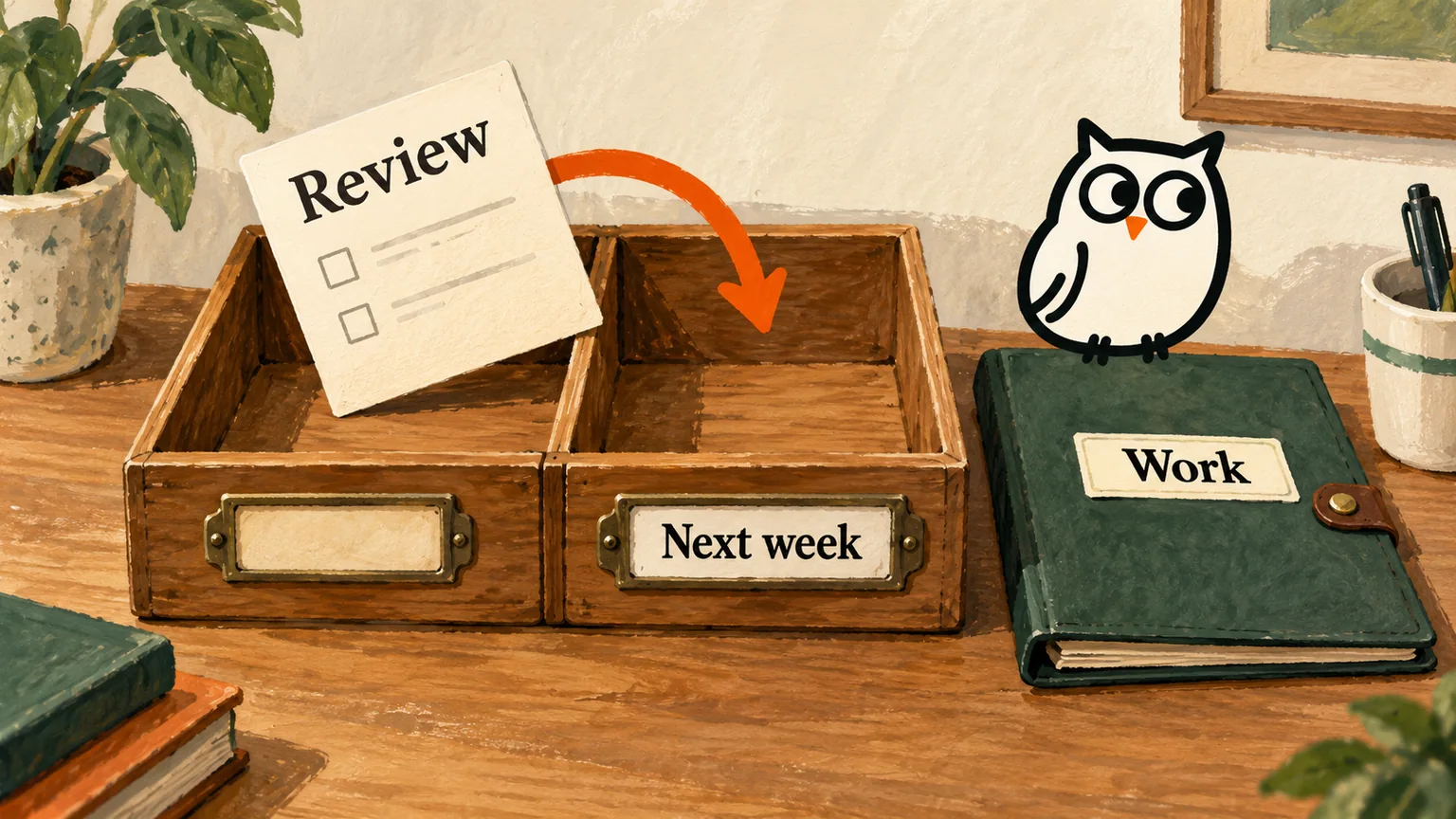
In Linus's fictional week, the Tuesday reading and 25-minute paragraph revision are completed. Thursday's remaining five minutes of material work and ten minutes of record keeping are also completed. The reserved 30-minute buffer is unused. Then an urgent current-work commitment makes the Saturday block unavailable before the application review begins.
Linus changes the calendar instead of borrowing an undisclosed work interval or marking the application complete. He moves the 45-minute review task to the first available 45-minute personal block next week. It replaces that block's planned new-role reading and drafting. Those new tasks move behind the existing review rather than becoming additional work on top of the same time budget.
Here is the completed before-and-after record.
| Item | Before the interruption | After the completed adjustment |
|---|---|---|
| Reading and material | Tuesday and Thursday assignments | 20 reading + 30 material completed |
| State record | Ten minutes allocated Thursday | Ten minutes completed; selected draft recorded |
| Application review | 45 minutes scheduled Saturday | Not started; moved to next week's first 45-minute personal block |
| Reserved buffer | 30 Thursday + 15 Saturday | Unused; not counted as completed work |
| Application state | Material prepared; review pending | Material prepared; review rescheduled; no submission |
| Next week's new-role tasks | Reading and drafting in the first block | Displaced behind the existing review |
The week's completed activity totals 60 minutes: 20 reading, 30 material, and 10 record keeping. The original 150-minute plan also reconciles after the interruption: 60 completed, 45 review minutes deferred, and 45 buffer minutes unused. No time or task disappears into a vague “busy week” label.
The completed fictional record accounts for the 60 performed minutes, 45 deferred review minutes, and 45 unused buffer minutes; it does not establish an application review. The change also keeps the application draft separate from the current-work folder. No employer artifact, private account access, or confidential material was used to compensate for the missed session.
This is a completed scheduling and state correction, not a completed application review. The next week's review remains planned. That distinction makes the example useful: you can finish organizing the disruption even when the substantive application task still needs attention.
Coordinate interviews as separate commitments
An interview invitation introduces a different kind of calendar demand. Reading a posting may fit into a short personal block; a scheduled conversation usually requires an uninterrupted interval, preparation, and a suitable setting. Record those demands before treating an invitation as compatible with your existing calendar.
Use scheduling options that you can actually honor and the leave or flexibility arrangements available to you. Confirm the time zone and the expected format with the employer's stated process. If you need to propose another time, give a clear availability range without disclosing confidential details about your current workplace.
Do not assume that every interviewer can accommodate an evening or that every current employer allows the same arrangements. If an interview consumes a personal block previously assigned to applications, replace that task in the plan. Keep the displaced draft in its accurate state rather than trying to preserve an application count by rushing its final review.
A private calendar entry can be brief while your personal notes hold the preparation details. Choose appropriate systems and privacy settings for your situation; a calendar's label alone does not guarantee who can view it. The goal is a commitment you can keep without importing current-work information into the search.
Review the plan through tasks and states
At the end of the modeled week, Linus can name the completed work and the remaining task. He has a duty note, a saved paragraph, a file record, and a revised calendar. He has not reviewed or submitted the application. That is a useful result with a clear continuation point.
For your own weekly review, compare reserved time with what actually happened. If a task repeatedly overruns, divide it into smaller pieces or give it a longer block. If current work repeatedly displaces a session, revise the calendar to a more realistic arrangement. The revised plan can preserve a clear next task when work disrupts the original schedule.
Write the selected draft and visible-form review as the next action, with imported fields and unresolved questions still to inspect. “Review the selected draft against the visible form” is more useful than “catch up.” It also explains why a prepared document remains in the queue until the necessary review takes place.
To begin your next personal block, choose a recently posted role on LandOffer, assign a bounded reading task, save its evidence note, and record the remaining review separately from any submission. A sustainable plan should fit your current commitments while preserving the difference between preparation, review, and submission.
Sources and Further Reading
- CUNY QCC: Creating a Job Search Plan — task organization, calendars, records, and periodic evaluation.
- UK JobHelp: Make a Plan — realistic time allocation, activities, and breaks.
- University of Michigan: Resume Resources — accurate editing and attention to sensitive employer information.