 LandOffer
Job search
Huntr Review: Tracking Applications and Tailoring Resumes in One Place
Huntr connects job records with role-specific resume materials, contacts and tasks. Current free limits and a completed two-role example show who should start free, consider Pro or keep an existing tracker.
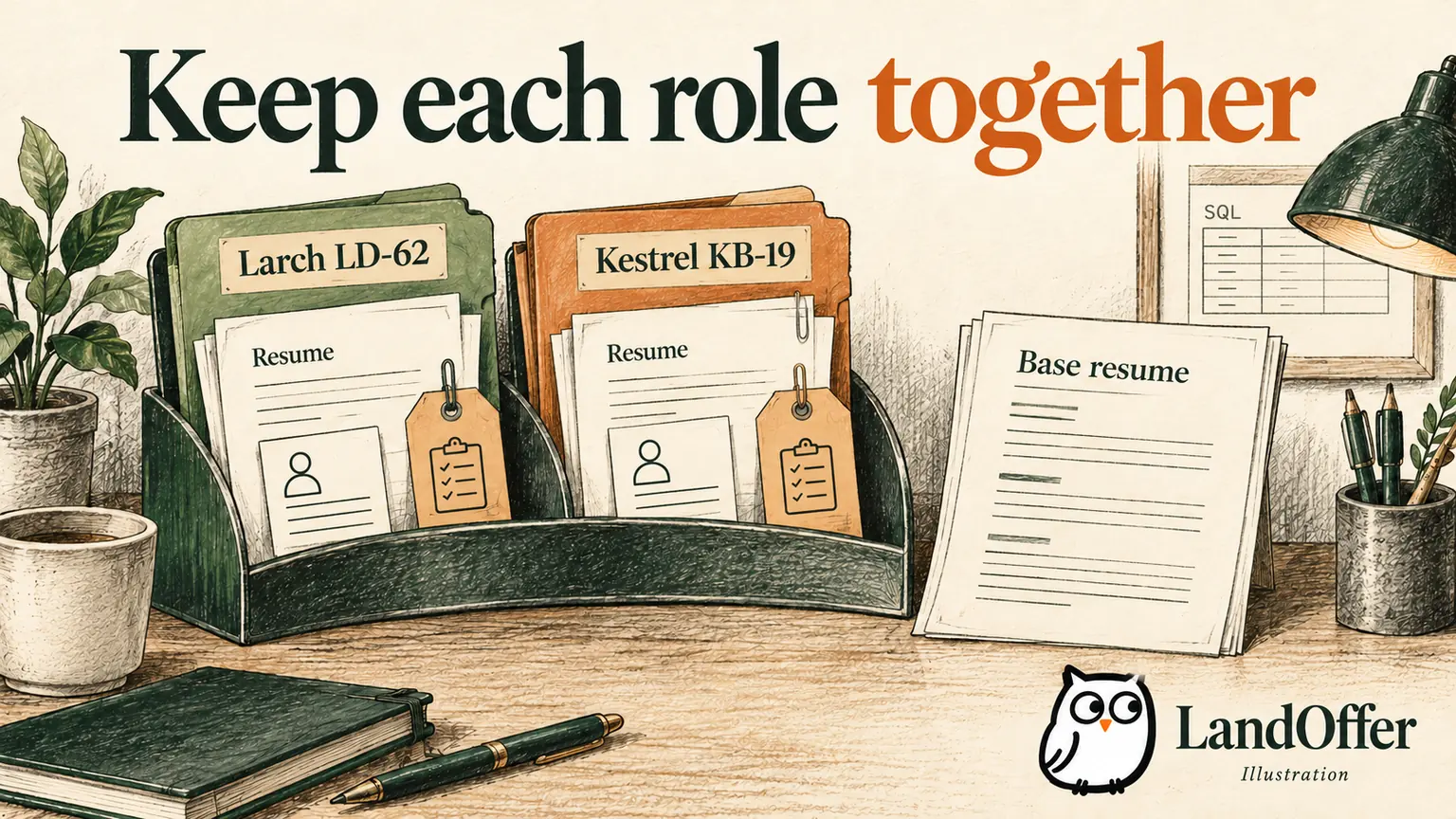
Huntr fits a search where each job needs its own reviewed resume, contact note and next action. Its free plan covers a small search with up to 100 tracked jobs and two tailored resumes; Pro becomes relevant when you need more tailored versions, application packets or advanced matching. Keep your current spreadsheet if it already gives you reliable records and you do not need an integrated resume builder.
This is a documentation review, checked October 8, 2026. We did not create a Huntr account, test its parsing or submit an application. LandOffer publishes this review and offers job-search tools, so it has a commercial interest in the category. You can browse recent roles on LandOffer.ai, then organize selected roles in whichever tool suits your search. Discovery and record keeping are separate decisions.
What Huntr puts in one place
Huntr connects its Job Tracker with its Application Hub. A saved job supplies context for a role-specific packet containing a tailored resume, cover-letter draft and application-follow-up template. The Application Hub guide describes choosing a base resume, editing the resulting materials and keeping the packet linked to its job.
That makes sense if your search repeatedly produces the question, “Which resume did I prepare for this role?” A packet can keep related materials together while a job card holds the posting and activities. It does not decide whether the role is eligible, whether the writing is true or whether the employer received anything.
Huntr also documents a Chrome job clipper, contact storage and application autofill. Those features share a workspace, but each has a separate input to maintain: the saved description, resume facts, contact details and autofill profile. Check the autofill profile separately so an old employment date does not reappear in the employer form after you corrected the resume.
The combined workspace is the main reason to consider Huntr. Buying another builder solely to obtain a nicer board is a weaker reason, particularly when your existing document editor and tracker already stay synchronized.
Free versus Pro: the limits that change the choice
The following decision table uses the pricing page and official plan FAQ, checked October 8, 2026. These are published allowances, not measured performance.
| Your actual need | Documented free boundary | Decision |
|---|---|---|
| Build a base resume and export a PDF | Unlimited base resumes, all templates and free PDF export | Start free; a PDF export alone does not justify Pro. |
| Keep a moderate pipeline | Up to 100 tracked jobs and 100 document uploads; unlimited contacts | Free covers those stated limits. |
| Keep separate role-specific materials | Two tailored resumes and two application packets | Two shortlisted roles fit the counts; a larger tailoring routine needs another approach or Pro. |
| Repeated AI tailoring and deeper analysis | Basic matching/scoring; limited complimentary AI credits | Pro lists unlimited tailored resumes, packets, AI generation, reviews and tailoring, plus advanced matching. |
Pro is $40 for monthly billing, $90 every three months or $160 every six months. The longer commitments work out to $30 and approximately $26.67 per month, but the upfront bills are $90 and $160. The six-month display rounds its monthly equivalent to $26.66. Compare the amount charged with your likely period of use.
A conflicting answer on Huntr's Job Tracker product page says Pro costs $30 per month without explaining the commitment. We use the dedicated pricing page and plan FAQ above: $30 is the quarterly equivalent, not the monthly bill.
Do not interpret two free packets as unlimited free AI generation. The dedicated pricing FAQ says there is no Pro trial and offers limited complimentary AI credits without stating a count. The help FAQ invites trial requests to support; that is not a published entitlement to a trial. Cancellation remains active until the billing period ends, then downgrades the account. Huntr says data remains accessible after cancellation, with Pro features restricted. That supports retaining records; it does not promise continued access to every paid editing action.
Save the whole posting, then choose a board deliberately
The Chrome extension guide distinguishes supported pages, where details populate, from unsupported pages, where the popup can be completed manually. It also tells users to review missing or incorrect details. We have not verified any particular employer site's capture accuracy.
The Job Card documentation gives the saved description a second purpose: it feeds AI analysis and tailored materials. Inspect responsibilities, qualifications, location restrictions and the original posting link before generating a packet. A clipped title alone is insufficient context for choosing relevant evidence.
Huntr's Job Board guide documents editable stages and an important restriction: jobs cannot move between boards. Saving to the wrong board requires adding the job again. For a candidate pursuing adjacent analyst and engineering roles, one board may therefore be easier to maintain than separate boards created before the shortlist is clear.
Use stages to describe actions you actually completed. The Activities guide says moving a job into certain stages automatically logs an activity because Huntr assumes the action happened. Moving a prepared application to Applied can make the board look finished while leaving you unsure what the employer received. This is a specific maintenance cost of stage-driven logging, rather than evidence that the employer acknowledged an application.
A completed example: two roles, one truthful foundation
The following is a fictional planning example. Samira, the employers and records are invented; the wording below is not observed Huntr output. It demonstrates how Huntr's documented organization can support a decision without pretending that we tested the account workflow.
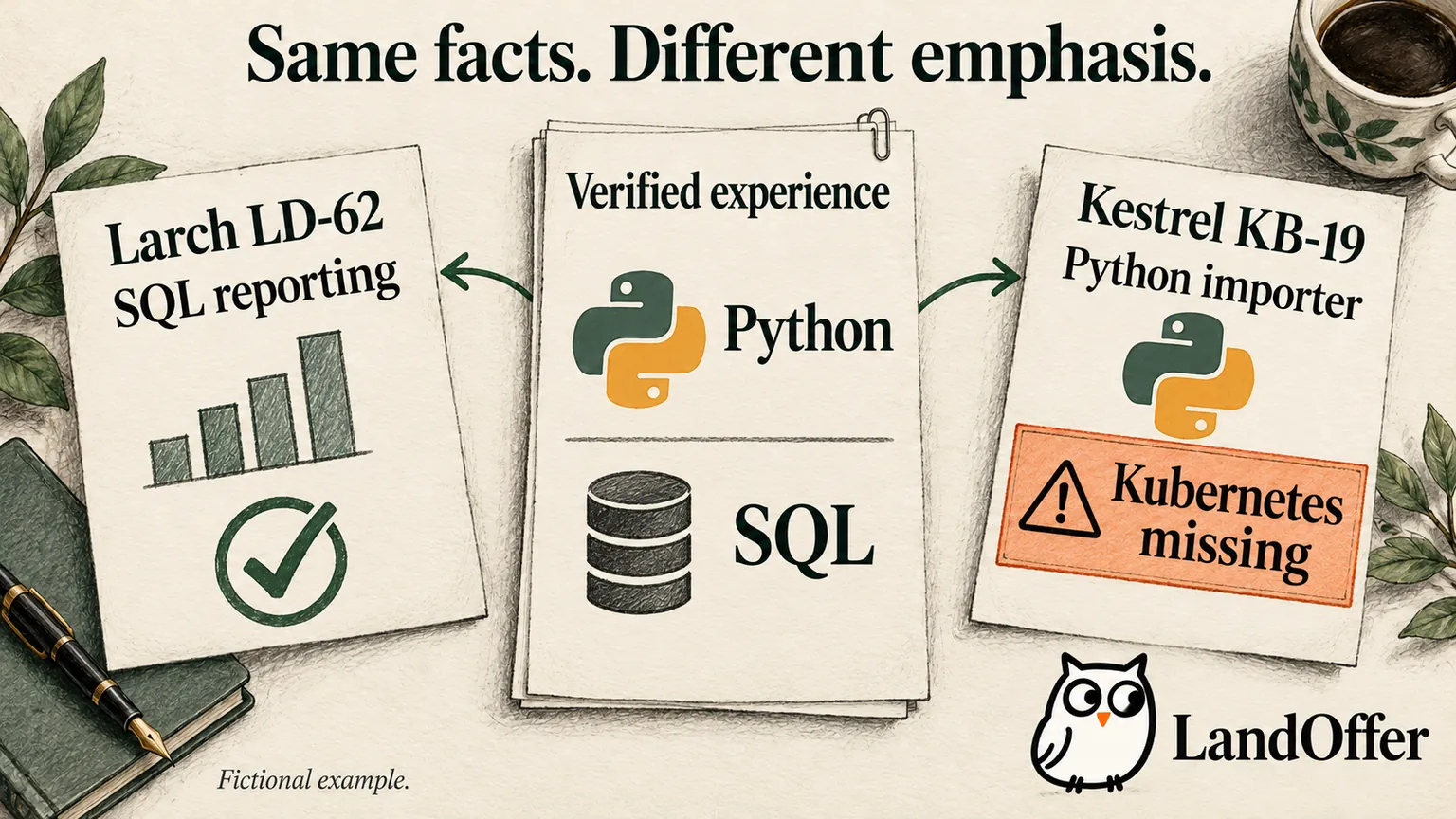
Samira's verified source notes describe a reporting internship at Maple Research, January–April 2026. She wrote a Python importer for weekly CSV files in PostgreSQL, added duplicate-ID checks and compared rejected records with the source file. She also prepared SQL cohort tables; a supervising analyst checked sample totals. She has no API-development, Kubernetes or production on-call experience.
She selects two fictional postings: Larch's Data Analyst role, LD-62, asks for SQL cohort reporting and clear written findings. Kestrel's Backend Engineer role, KB-19, requires Python API development, Kubernetes service deployment and production on-call work. Each job record keeps its full description and reference. Samira chooses one board so both opportunities remain visible.
Her base resume preserves the actual internship title, dates and contributions. Huntr's Resume Builder guide distinguishes this comprehensive source from tailored copies focused on individual jobs. Samira can start from that foundation without turning every missing requirement into an achievement.
For Larch, the completed tailored bullet is:
Queried weekly CSV imports in PostgreSQL to produce monthly cohort tables, and checked sample totals with the supervising analyst.
For Kestrel, the same experience supports a different, narrower bullet:
Built a Python CSV importer for PostgreSQL with duplicate-ID checks and compared rejected records with the source file.
The second bullet offers relevant engineering evidence. It does not supply the API, deployment or on-call experience Kestrel requires. An assistant suggestion to “deploy Python services on Kubernetes” would be rejected because Samira's notes do not support it. This is a hypothetical suggestion to audit, not a claim that Huntr generated it.
The finished planning record is:
| Record | Larch LD-62 | Kestrel KB-19 |
|---|---|---|
| Resume version | Samira_Larch_LD62_2026-10-08_v1.pdf | Samira_Kestrel_KB19_2026-10-08_v1.pdf |
| Defensible emphasis | PostgreSQL cohort queries and checked totals | Python importer and duplicate-ID checks |
| Missing evidence | No additional required gap in this fictional posting | Required API, Kubernetes and on-call experience |
| Contact note | Sam, analyst contact; no referral promised | No verified contact yet |
| Next action | Read the exported PDF and employer form | Hold application; pursue roles matching current experience |
| Submission state | Prepared, unsent | Prepared, unsent |
These two records fit the published free quantities for tailored resumes and packets. The exact availability of complimentary AI actions still depends on the remaining allowance; Samira can edit truthful text herself. The completed decision is to proceed with Larch after review and hold Kestrel, rather than submit both because both now have documents.
Huntr's Contacts and Documents guide documents linking contacts to opportunities and storing materials. In this example, Sam's note belongs with Larch, while each exported filename identifies its employer and role. That association is useful during preparation even before either application is sent.
Read matching feedback without turning it into a hiring forecast
Huntr separates a base Resume Score from a tailored Job Match Score. The builder guide describes the first through section completion, content quality and length; the second addresses relevance to a particular role. Neither is an employer's decision or a demonstrated interview probability.
The responsibilities and qualifications guide documents suggestions, review controls and the ability to ignore items so they no longer affect the score. That last control matters: excluding a requirement can change the tool's evaluation without changing the employer's requirement.
For Samira, ignoring Kubernetes could make the remaining comparison look better, but Kestrel's required deployment experience would still be absent. Keep that gap in the job note and judge eligibility against the original posting. Use the report to find overlooked evidence or improve wording, then read the result yourself. A higher score is not a reason to invent an experience, nor is an incomplete score automatically a reason to abandon a genuinely suitable role.
Autofill and packet actions still need accurate records
Huntr's extension documentation says autofill uses the Huntr Profile and needs a visible application form on a site that permits the extension. Its unlimited free autofill allowance is a usage limit, not a promise of universal portal support. Inspect the filled fields and uploaded file in the actual employer form.
The Application Hub guide describes Download & Apply as downloading documents and opening the posting URL. It separately documents Mark as Submitted, which changes the packet to Applied. Those are distinct actions. In Samira's example, neither prepared packet is marked submitted. After an actual application, she would record the employer-side confirmation with its role reference.
Also consider cleanup: the same guide says deleting a tracked job permanently deletes its associated packet. Deleting only the packet leaves the job available for a new packet. If the role closes, preserve the materials and history you need before deleting its job record; a housekeeping click can remove more than a visible board card.
Privacy and leaving Huntr
Huntr's privacy policy, last modified February 8, 2024, describes resume and profile information, third-party services for functions including AI content creation, and organizational access when you accept an organization's invitation. It also says sharing a board shares all data in that board with the other user. Those are meaningful choices if notes include recruiter details or private job-search context.
Before sharing, review the whole board rather than assuming only the displayed card is exposed. Keep confidential employer material out of an uploaded resume, and read the invitation's sharing implications if a school or career program provides access. The published policy is evidence of stated practices; we have not audited Huntr's handling or security.
Huntr's export guide describes Download My Data as a ZIP with CSV files for job, activity, profile and contact data. A separate Metrics export serves activity insights. That offers a route to retrieve records, but we have not checked whether every attachment or resume layout round-trips into another tool. Keep independent copies of the PDFs you actually use.
Who should use Huntr, and who should skip it?
Start free if you want a visual pipeline and a small number of role-specific resumes kept alongside contacts and tasks. Samira's two-record example fits that purpose. Consider Pro when the integrated tailoring routine itself is valuable and the free version's limits interrupt that routine. Paying upfront makes more sense when you already know you will use it for the full period.
Keep your current setup if you apply to a few similar roles with one accurate resume, or if a spreadsheet and existing editor already connect the documents reliably. Skip Huntr as a purchase for guaranteed ATS approval, automatic employer confirmation or verified end-to-end auto-apply: this review establishes none of those outcomes. Its documented strength is organized preparation with resume tools, and its cost is maintaining several connected sources of information honestly.
Choose one relevant role from LandOffer.ai's recent listings, verify the employer's current posting, then save its full description and create one reviewed version in your chosen tracker. Finish that one record before adding more roles; you can keep your existing tracker for this check.
Sources and Further Reading
- Huntr pricing: plan quantities, billing periods, AI allowance and cancellation.
- Huntr plan FAQ: free and Pro feature boundaries.
- Application Hub and Packets: role-linked materials, packet actions and deletion behavior.
- The Huntr Chrome Extension: capture fallback and autofill conditions.
- The Job Board, Understanding the Job Card and Activities: board organization, descriptions and stage-triggered logs.
- Resume Builder and Responsibility & Qualifications Matching: base/tailored copies and scoring controls.
- Contacts and Documents, Download/Export Your Board and Privacy Policy: records, export and sharing.