 LandOffer
Job search
Frontend Engineer Resume: Show UI Quality, Accessibility, and Performance Work
Show frontend work through interaction behavior, scoped accessibility checks and defensible performance evidence, with completed resume examples.

A frontend engineer resume should show what a person could do more clearly, reliably or efficiently because of your work. Describe the interaction you changed, the technical decision behind it and the checks that support your claim. A framework list identifies your tools. The work and its checks establish what you can claim about UI quality, accessibility and performance.
Start with the responsibilities in one opening from recent roles on LandOffer.ai. LandOffer publishes this guide and offers job-search tools. The examples below are fictional teaching cases, informed by public technical guidance checked on October 9, 2026. They are not results from a tested application or evidence of hiring preferences across every employer.
Choose an interaction the reader can understand
Begin with a task: buying a ticket, filtering a catalog, editing a profile or recovering from a failed upload. Then identify the part you personally changed. “Built responsive interfaces using React” leaves the reader guessing about the problem, the complexity and your contribution. A checkout that retained entered details after a validation error provides a much clearer subject.
Read the target description for the kind of responsibility it emphasizes. A product frontend role may ask for collaboration with design and careful handling of loading, empty and error states. A design-system role may emphasize reusable components, documentation and adoption. A performance-focused role may require measurement and diagnosis. These are different reasons to select a project, even when all three use TypeScript.
Make a private evidence note before drafting. Record the starting behavior, your change, the affected surface, the verification and the boundary of responsibility. Include what was left unresolved. That last detail prevents a partial improvement from becoming a claim that you rebuilt the whole experience.
Prefer a coherent set of examples to a separate bullet for every library. Three related bullets can show implementation, quality checks and collaboration without repeating the same achievement. Keep technologies in a compact skills section and mention them in experience when they explain a decision. Naming React is useful if the work concerned component state or rendering; it adds less when the sentence only says that a page existed.
A completed evidence map for a checkout flow
Consider Nadia Chen, a fictional engineer at Fernline Events. She worked on the attendee-details step of a ticket checkout. A designer supplied the visual language; a backend colleague owned payment processing and server-side validation. Nadia implemented frontend interaction states and collaborated with QA on regression checks.
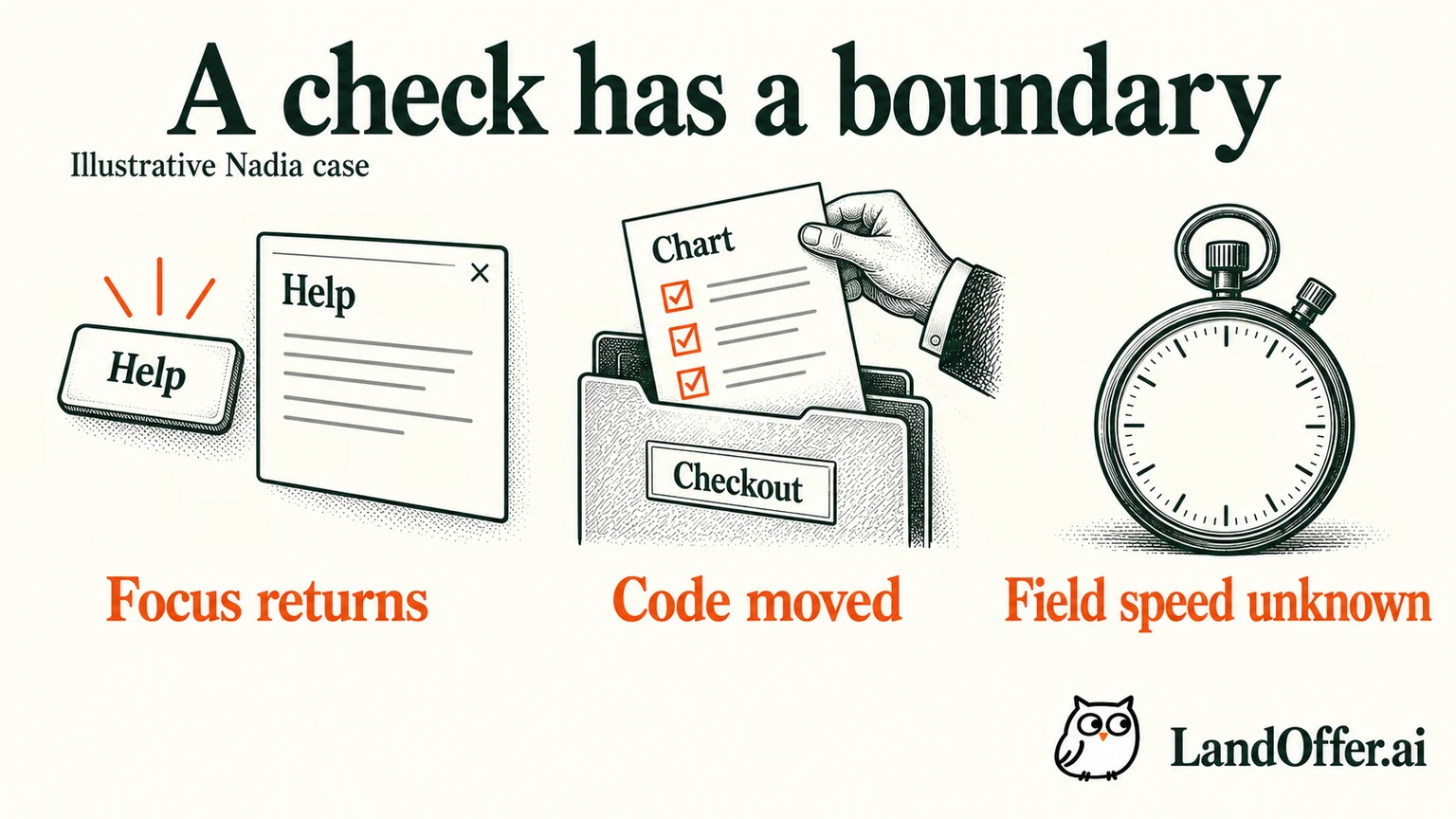
The stipulated project record contains three changes. Invalid fields previously cleared when the user retried. Closing a help dialog left keyboard focus at an unpredictable place. A reporting chart was imported by the checkout route even though the chart appeared only in the organizer area. These are invented facts for this example, not observations of a real product.
| Work record | Nadia's contribution | Supported public description |
|---|---|---|
| Attendee data disappeared after a rejected form submission | Preserved valid field values and linked field-level errors to their controls | Implemented recoverable validation states for attendee checkout |
| Help dialog returned keyboard users to an unclear position | Restored focus to the triggering control and added a regression case | Fixed dialog focus restoration in the checkout flow |
| Organizer chart entered the checkout route's import path | Moved the chart import behind its organizer route and reviewed build output | Removed an unrelated chart dependency from checkout's initial route code |
Nadia can now choose a bullet for recovery, keyboard interaction or code loading without describing the same contribution three times. Nadia can describe implementation and bounded verification. She cannot claim higher ticket sales, complete accessibility conformance or faster real-user interactions from these records alone.
Keep the map for interview preparation as well. She can explain why preserving valid values mattered, how focus restoration was checked and why route ownership made the chart unnecessary. A list of three impressive adjectives would give her much less to discuss.
Turn the map into finished resume bullets
Nadia's initial note reads: “Worked on checkout improvements and made the experience better.” It identifies a surface but hides the behavior. Her finished experience section can instead say:
- Implemented attendee checkout states in React and TypeScript, preserving valid inputs after validation errors and adding regression checks for retained fields on retry.
- Fixed help-dialog focus restoration and field-error associations in checkout; documented the keyboard paths reviewed with QA.
- Moved an organizer-only chart import out of checkout's initial route code and checked the resulting build output with the frontend lead.
Each sentence makes a different contribution visible. The first concerns recovery, the second concerns interaction access and the third concerns code loading. None claims ownership of payment processing or the entire design system.
A shorter resume might combine the first two bullets if they came from one small change. A role emphasizing performance could place the import work first, provided Nadia can explain the build evidence. Ordering changes emphasis without changing the facts.
A sentence can feel modest without a business number. Keep the result you can explain instead of filling that gap with an unsupported claim. “Increased checkout conversion” would require a defined measure and evidence connecting the change to that result. The completed behavior is already an outcome: entered details remain available after a failed attempt. Explain that behavior rather than attaching a number from elsewhere in the team.
Keep the public wording proportionate to the available evidence. A merged change records integration; release evidence establishes delivery, and a passing regression supports a behavior under its tested conditions. These records do not establish that every browser, device, account state or future release behaves identically.
Describe accessibility work at its actual scope
Accessibility is more useful on a resume as work you can explain than as a blanket quality label. Name the barrier, the affected interaction and the evaluation you performed. Keyboard navigation, focus placement, accessible names, contrast and error communication are different concerns; completing one does not resolve all of them.
The W3C WCAG overview explains that conformance is determined by success criteria at specified levels. A statement such as “made the platform WCAG compliant” therefore carries much more scope than “fixed focus restoration in the help dialog.” Use the narrower sentence when it matches your record.
For Nadia, the private review note identifies the checkout step, the browser used and the keyboard sequence: open help, move through its controls, close it, then continue from the trigger. If she also reviewed a screen reader, she should name the relevant environment in her supporting notes. Do not add assistive-technology testing that never happened.
Automated checks can contribute evidence, but they cannot settle every accessibility question. W3C's evaluation-tool guidance explicitly describes that limitation. A clean scan is therefore a scan result, not proof that every user can complete every task.
Keep a meaningful boundary in the resume when it changes interpretation. “Addressed checkout keyboard barriers” is defensible for scoped fixes. “Led an accessibility program” would require responsibility for a program, including priorities, coordination and follow-through. Participating in one review does not establish that leadership.
Separate performance implementation from measured improvement
Performance work has at least two kinds of evidence: what you changed and what you measured afterward. The first can be valuable without the second, but they should not be merged into an unsupported result.
In Nadia's case, moving an unrelated import provides an implementation fact. Reviewing build output can establish that the dependency moved outside the initial route code under that build configuration. It does not establish a reduction in Largest Contentful Paint or an improvement in Interaction to Next Paint for production users.
web.dev's Web Vitals guidance distinguishes development measurements from field experience. It also notes that a simulated Lighthouse page load does not measure INP because there is no user interaction. Use metric names accurately and avoid treating a general performance score as a result for every interaction.
When you do have measurements, preserve the conditions: page and build, device category, network assumptions, tool or data source, collection window and aggregation. A median from repeated local runs and a percentile from production visits answer different questions. Keep baseline and comparison conditions aligned, and record other changes that could affect interpretation.
If the measurement is missing, write the implementation claim. “Deferred organizer chart loading outside the checkout route” is specific without a speculative speed benefit. If reliable field data later becomes available, revise the bullet to include the measured scope rather than retroactively treating the earlier build inspection as proof.
Do not borrow the largest number in a dashboard. A team-wide improvement may have involved image delivery, server latency and analytics changes alongside your code. State your contribution to that effort and use a shared result only with its attribution intact.
Audit the claim before making it stronger
Nadia's second completed asset is a claim audit. It compares what the fictional record establishes with wording that would exceed it.
| Available evidence | Defensible claim | Claim to leave out |
|---|---|---|
| A documented keyboard path and regression for returning focus | Fixed and checked focus restoration in the help dialog | Certified the entire site as accessible |
| Build output showing the chart outside initial checkout code | Separated organizer chart loading from checkout | Improved production INP by an unmeasured percentage |
| Frontend error states reviewed with QA | Preserved form inputs during validation recovery | Secured payment processing end to end |
The final row also protects the technical boundary. MDN's form-validation guide explains that client-side validation does not replace server-side checks. Nadia should describe her UI behavior without presenting it as ownership of backend security.
Apply this audit to your strongest verbs. “Designed” should identify the decision you made. “Owned” should identify the responsibility you carried beyond writing code. “Standardized” should identify where the standard was adopted. If a verb outruns the evidence, change the verb or supply the missing scope.
Maintain this evidence privately. A resume does not need links to internal tickets, customer sessions or confidential dashboards. Public repositories and demonstrations can help when sharing is permitted, but a clear explanation of the check is often more appropriate than publishing work artifacts.
Adapt the evidence to your career stage
An early-career candidate can use a personal or course project, provided its setting is clear. Describe the implemented interaction and the checks you actually completed. A deployed demo is not automatically a production service with paying users, and testing with friends is not a formal accessibility study.
For experienced engineers, show how the work affected maintenance and collaboration as well as the immediate screen. Did you document component behavior for another team, add regression coverage to a shared package or coordinate a rollout that preserved existing users' workflows? Select the part you carried, rather than absorbing everyone's contribution into one broad sentence.
A design-system example needs adoption evidence. Creating a component and getting it used across product surfaces are different achievements. Name the surfaces or teams when that information is shareable. Without adoption records, describe the component and its documented states instead of inventing a scale claim.
Before sending the resume, read the chosen bullets without the skills section. The reader should still understand the user task, your contribution and the verification. Then check that the technologies, dates and ownership agree with the rest of the application.
Use recent roles on LandOffer.ai to choose one relevant frontend opening. Use the opening for role selection, then build an evidence note for one responsibility and write a bullet you can explain from problem through check. Keep the outcome as narrow as the evidence supports.
Sources and Further Reading
- W3C: WCAG 2 Overview: success criteria, conformance levels and current standards context.
- W3C: Selecting Web Accessibility Evaluation Tools: automated evaluation limits and human review.
- web.dev: Web Vitals: field and lab measurement boundaries, including INP.
- MDN: Client-side Form Validation: frontend validation and the continuing need for server-side checks.
Public guidance checked October 9, 2026. Nadia, Fernline Events and all project records are fictional illustrations; no performance benchmark or accessibility audit was executed for this article.