 LandOffer
Job search
Applying to an Early-Stage Startup: Show How You Work with Unclear Requirements
Show startup employers how you clarify unclear requirements, limit scope and check results. Use a completed decision record and a truthful application answer.
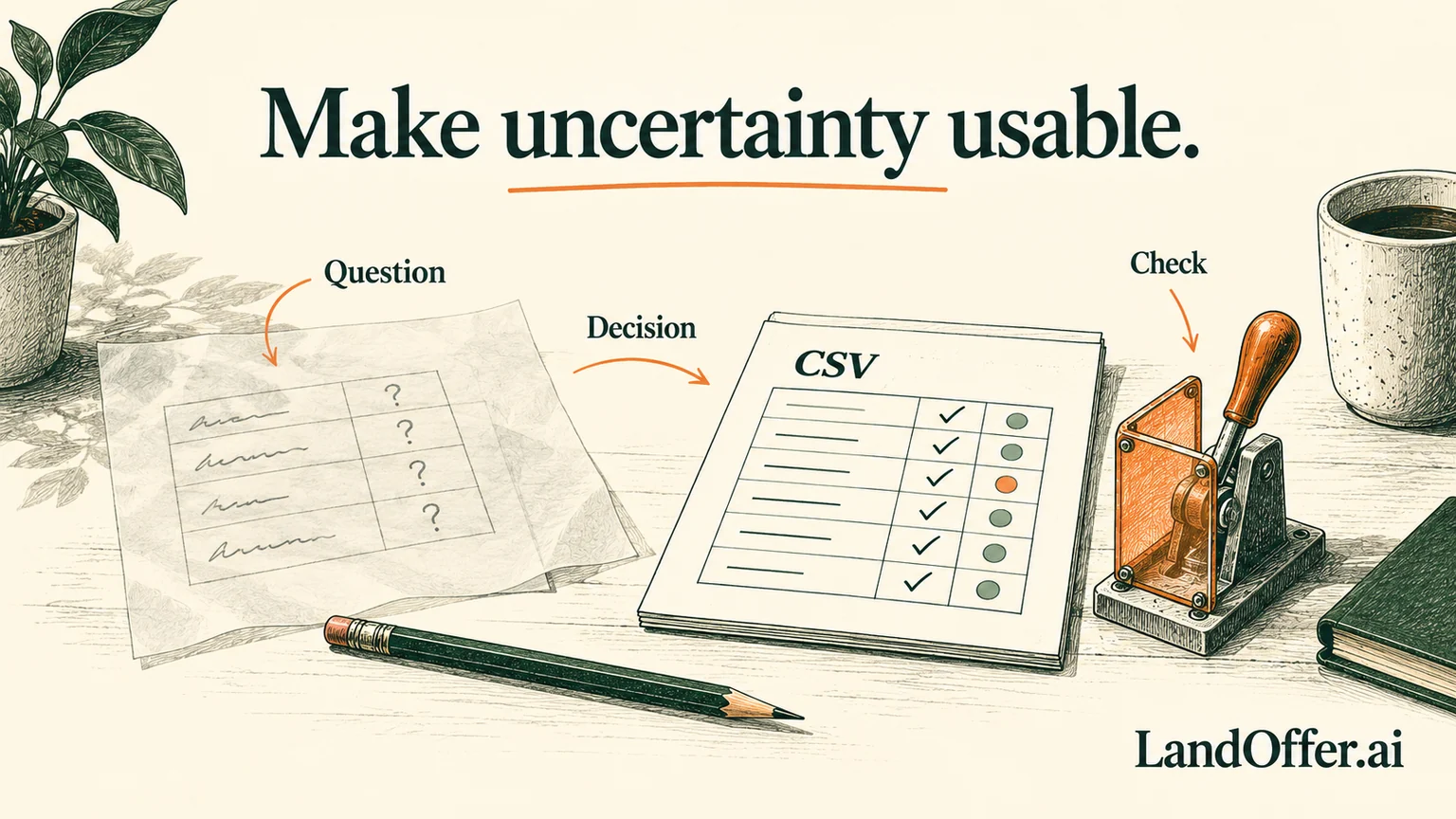
When applying to an early-stage startup, show how you made progress when the problem or requirements were incomplete. Explain the question you clarified, the assumption you recorded, the small decision you made and the check that determined what happened next. A specific example lets a reader assess your judgment instead of relying on a personality claim. It also helps you assess whether the employer provides enough context and support for the work.
Use recent roles on LandOffer.ai to find leads, then read the company's actual responsibilities. LandOffer publishes this guide. Primary references were checked October 9, 2026. Ari, MintDock and the complete onboarding example below are fictional. They demonstrate application writing and decision records, not a shipped product, customer result or hiring outcome observed by LandOffer.
Identify which uncertainty the role actually contains
Early-stage roles can involve unclear customer needs, incomplete product definitions, changing priorities or unfamiliar technical constraints. Each type of uncertainty calls for different questions and evidence. Read the description for the decisions the person will make and the information they will have access to before assuming that all startup work means doing everything alone.
An engineer asked to interview users and propose a first workflow needs different evidence from someone implementing a specified feature in a small codebase. A role owning customer support as well as delivery creates another set of commitments. Record what the posting states and leave unstated responsibilities as questions.
Choose an example from your own work that matches the relevant uncertainty. You might have clarified an internal process, narrowed a research question or decided how to handle incomplete input. The setting does not need to be a startup. It does need to be accurate and sufficiently concrete to explain what you did.
Separate the missing information from your authority to act on it. You may have proposed a decision that a manager approved, implemented within a policy or escalated a risk outside your remit. Those boundaries belong in the story. “Owned the product” is not a useful translation of “suggested a small change to an internal tool.”
Start with evidence about the problem
Before describing the solution, explain how you learned what was going wrong. A recent example, an observed task or an existing error record is more informative than a general impression that a process was inefficient. Preserve the difference between what someone reported and what you directly checked.
YC's Startup School recap on talking to users emphasizes asking about specific experiences and existing attempts to solve a problem. That is founder-education guidance, not a hiring rubric. Its relevance here is the habit of investigating the task before deciding what to build.
For an application story, explain the piece of evidence that changed your interpretation. Perhaps a requested dashboard was really a need to find missing records. Perhaps a proposed automation would move an error downstream instead of removing it. The reader should understand why your next action followed from what you learned.
If your knowledge was incomplete, say how you bounded the decision. “We had not yet checked a second customer type” is a useful limitation when it explains why you restricted a pilot. It does not weaken a story whose value lies in avoiding an unsupported expansion.
Read a completed ambiguity-to-decision record
In the fictional case, Ari is an engineering intern at MintDock, a small logistics-software team. An operations lead asks for “automated customer onboarding.” Ari has permission to investigate and propose a limited internal prototype, but account creation and production changes require review by the lead engineer.
Ari watches the operations lead review a sample import and asks about the last failed attempt. The stipulated finding is that missing customer identifiers are discovered late, while the existing manual workflow already handles account creation. Ari proposes a read-only validation preview for one account type. These are invented case facts, not an account of research conducted with a real company.
| Uncertainty or evidence | Question or check Ari completed | Decision recorded | Condition for revisiting |
|---|---|---|---|
| “Automate onboarding” did not name the immediate failure | Reviewed the last failed sample with the operations lead | Focus first on detecting missing required identifiers | Other failures become more important in later reviewed samples |
| Several account types existed | Confirmed which type the lead could provide examples for | Limit the prototype to that one type | Additional types have explicit rules and sample inputs |
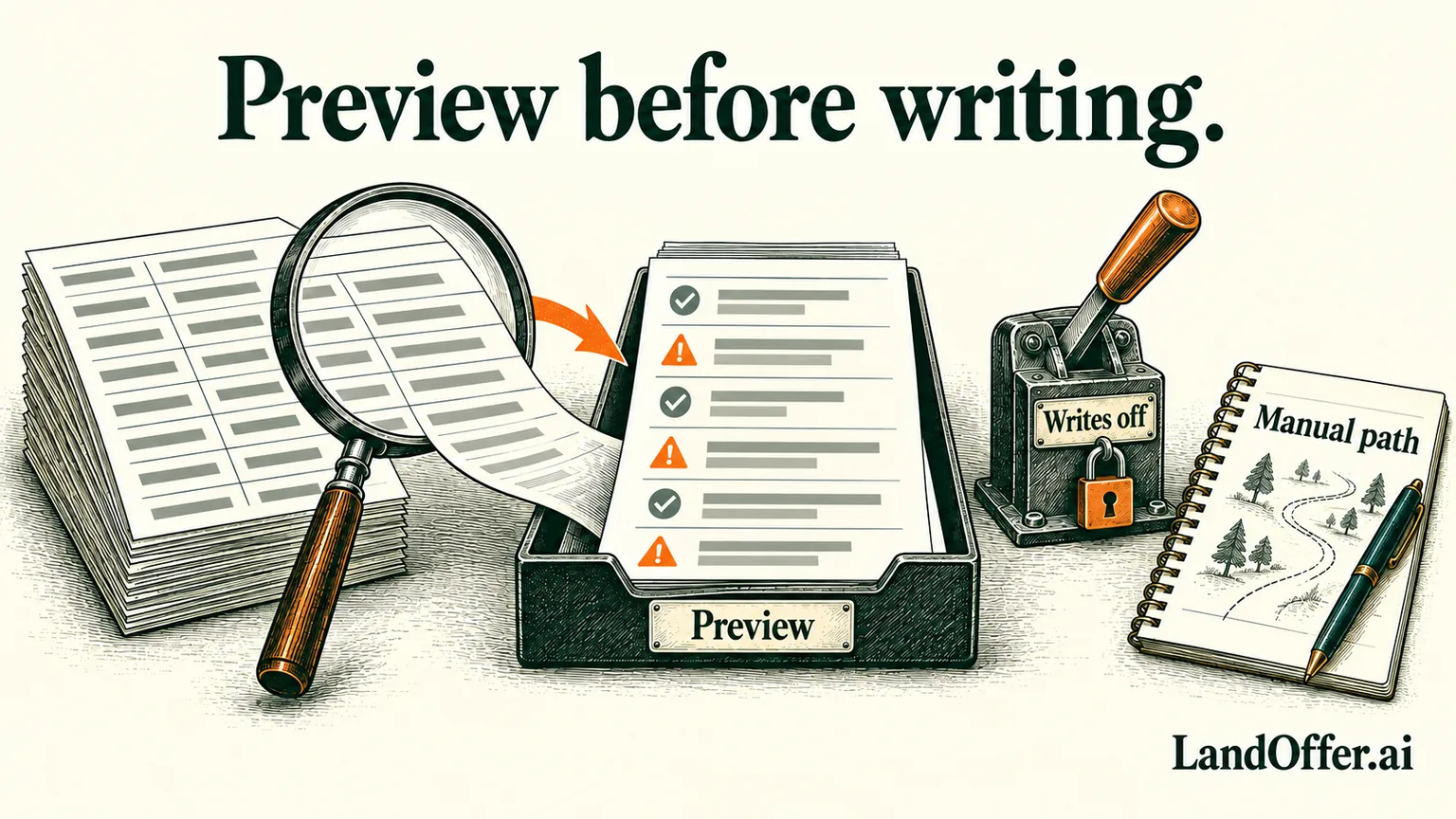
| Creating accounts could affect live records | Confirmed approval boundary with the lead engineer | Keep writes off; show a preview only | A separate reviewed implementation approves write behavior |
| Existing manual work remained necessary | Checked how the operations lead completed the current task | Retain the manual path and document the handoff | A later release deliberately replaces that path |
| “Works” had no agreed meaning | Agreed three synthetic fixture cases before implementation | Check missing identifier, valid row and duplicate identifier behavior | A new input exposes an unhandled case |
The record gives a reviewer enough information to assess Ari’s decision without assuming he automated the entire onboarding process. Ari did not solve customer onboarding as a whole. He identified a tractable failure, confirmed who could approve changes and completed a prototype that addressed that failure within an agreed boundary.
The revisit conditions matter because requirements may change. Ari did not declare that the other account types were unimportant. He deferred them until the team had the information needed to define their behavior. That is a decision with a reason and a trigger, rather than an arbitrary refusal to do more work.
The story also preserves collaboration. The operations lead supplied workflow knowledge, the lead engineer established the production boundary and Ari implemented the preview. A strong application can describe Ari's contribution without erasing the people whose information made the decision possible.
Describe a completed check and a limited result
In this fictional prototype, a missing identifier produces a row-level error, a valid synthetic row appears in the preview, and a duplicate identifier is flagged. All three checks occur without writing account records. In the stipulated case, the operations lead reviews only the sample output, and the manual workflow remains available.
That is enough to describe a bounded result: the prototype exposes specified input problems before a proposed write. It does not establish fewer customer failures in production, shorter onboarding time, increased revenue or adoption by the team. Ari has no measured evidence for those outcomes and leaves them out.
YC's official MVP lecture discusses launching a limited initial product and learning from feedback. The application-writing lesson is an editorial adaptation: explain why the smallest useful version answered your current question. An internal preview is not automatically a launched MVP, and that label would add no clarity to Ari's actual result.
A technical reader may ask what happens with malformed files, unexpected encodings or a new account type. Ari can explain that those were outside the three-case fixture and identify the next investigation. He should not answer by expanding the original claim to “all invalid input.” Keeping the check precise makes the example easier to investigate.
Turn the record into a specific application answer
Suppose a fictional application asks, “Tell us about a time you worked with unclear requirements.” Ari can use the decision record to produce the following answer. It is an illustrative draft based only on the stipulated case, not text a candidate should adopt as personal history.
During my MintDock internship, an operations lead asked for automated onboarding without defining which step was failing. I reviewed a failed sample with the lead and found that missing customer identifiers were being discovered late. I proposed a read-only CSV validation preview for one account type, rather than creating accounts automatically. The lead engineer confirmed that production writes needed separate review. I implemented row-level errors and checked three synthetic cases: a missing identifier, a valid row and a duplicate identifier. The operations lead reviewed the output, and we retained the manual workflow. The prototype demonstrated those checks; we did not measure production time savings. I documented the deferred account types and the information needed before expanding the scope.
The answer names the ambiguity, evidence, decision, collaborator, completed check and remaining limit. It avoids personality claims that a reader cannot assess. It also gives an interviewer several useful follow-up questions: why one account type, how duplicates were identified and what would justify enabling writes.
If the prompt asks why you fit this particular role, add a separate sentence connecting the example to a responsibility actually stated in the posting. For example, a role explicitly involving operator interviews and import workflows has a clear connection. A role focused on infrastructure operations may call for a different example.
If there is a character limit, preserve the decision and its evidence before cutting the background. Delete repeated setup and generic enthusiasm. Do not remove the synthetic-data or preview boundary if the shorter answer would then imply a production deployment.
Prepare an artifact you can explain safely
A permitted work sample can support the story when it makes the decision easier to inspect. Use a sanitized decision note, synthetic fixture or independent reconstruction when original employer material cannot be shared. Clearly label the reconstruction so the reader does not mistake it for the original internal artifact.
Keep the artifact focused on the decision and its three input cases. A README can explain the problem, permitted scope, three input cases, expected behavior and deferred work. A screenshot of sample output can be useful if its provenance and limits are clear. A large repository with no explanation may make the contribution harder to understand.
Check ownership before sharing. Ari can describe the general method, but internal customer files and credentials are not evidence to paste into an application. If the work belongs to an employer, ask through the appropriate channel before making it public. You can still write a precise resume bullet without exposing protected details.
For a new employer's take-home task, clarify the time expectation, evaluation criteria, data access and expected deliverable. A small assessment and production work for a live customer are different commitments. Resolve a request for access or operational responsibility before treating it as a normal requirement to prove enthusiasm.
Evaluate how the startup handles uncertainty
Your application demonstrates judgment; the interview should also help you assess the environment. Ask who supplies customer context, who decides priorities and who reviews changes with operational consequences. A role can offer autonomy while still having clear review boundaries.
Useful questions follow from the work: “When two customer requests conflict, who makes the trade-off?” “What would a useful first contribution look like?” “Who reviews changes before they affect customer records?” “Which support or on-call responsibilities are part of this opening?” The answers help you compare the role with your experience and practical constraints.
Ask business questions as the process develops. YC's advice on choosing a startup recommends discussing runway and funding plans and assessing the quality of founders' answers. The article is dated 2021; its questions are useful prompts, not a current assessment of any company's finances or a promise of job security.
Keep public evidence and employer statements separate in your notes. A funding announcement does not establish current cash runway, and YC affiliation does not establish that the job fits your circumstances. Record what the employer says and which uncertainty still matters to your decision.
If the role requires acting without access to the people or information needed to make responsible decisions, examine that mismatch directly. Enthusiasm for a small team does not require promising unlimited availability or accepting ownership you cannot exercise. A clear role can still contain substantial uncertainty about the product.
Choose one relevant opening from recent roles on LandOffer.ai, record one unresolved responsibility or decision from its description, then select a truthful example showing how you clarified, bounded and checked comparable work. Bring equally concrete questions about how the team will support that responsibility.
Sources and Further Reading
- YC: Startup School Week 1 Recap — primary transcript on investigating specific user problems.
- YC: Michael Seibel, How to Plan an MVP — official lecture on limiting an initial product and learning from feedback.
- YC: How to Pick the Right Startup to Work For — dated advice on business questions and evaluating founders' answers.