 LandOffer
Job search
DevOps and SRE Resumes: Describe Reliability Work Without Exposing Sensitive Details
Describe releases, on-call contributions and reliability work on a DevOps or SRE resume while preserving ownership and sensitive operational details.
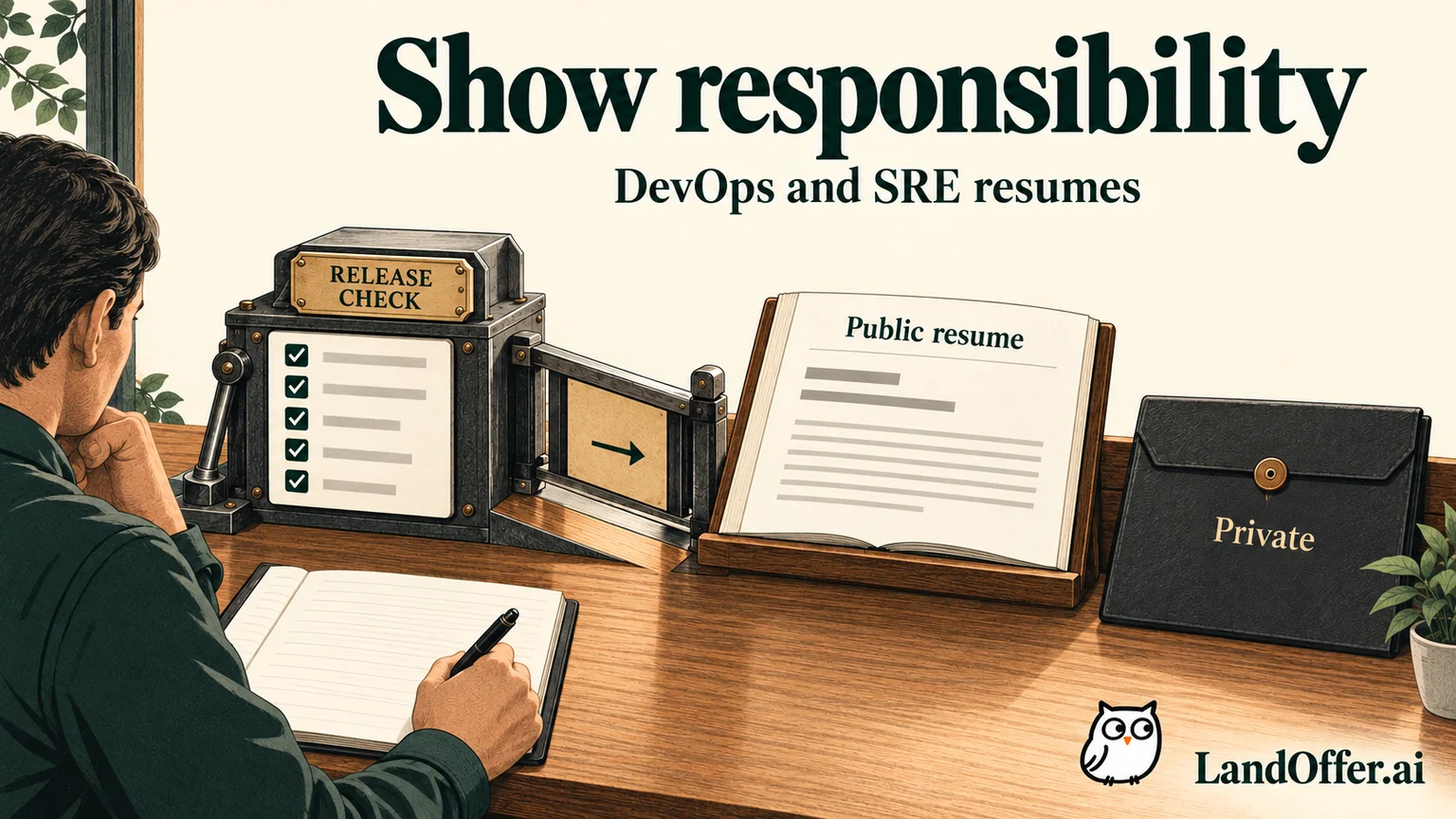
A DevOps or SRE resume should explain which release, operational or reliability responsibilities you carried and what evidence shows the work was useful. Describe the decision, safeguard or follow-through without publishing credentials, internal topology, customer details or exploitable failure conditions. State your responsibility and the result you verified. The resume does not need a diagram of your employer's systems.
Choose the responsibilities in a target opening from recent roles on LandOffer.ai before selecting examples. LandOffer publishes this guide and offers job-search tools. Public engineering references were checked on October 9, 2026. The candidate and operational records below are fictional teaching examples, not a disclosure about a real service or an executed reliability experiment.
Read the responsibility behind DevOps or SRE
Titles are a starting point. One DevOps opening may emphasize build pipelines and infrastructure configuration; another may include application support, access administration and deployment coordination. An SRE opening may emphasize service indicators, incident response, capacity and engineering work that reduces repetitive operations. Read the actual duties rather than assuming a title defines the whole job.
Mark the recurring responsibilities in the posting. Then select evidence showing you performed those tasks at the relevant scope. A list containing Kubernetes, Terraform, Linux and several cloud services does not explain whether you maintained a module, designed a release process or responded to a production incident.
Attach each tool to a purpose so the reader can distinguish maintenance, design and operational responsibility. “Maintained Terraform modules used to configure staging services” is clearer than “expert in infrastructure as code” when maintenance was the work. If you designed the module interface, reviewed migration risks and coordinated adoption, those decisions can support a broader account.
For a role spanning development and operations, show both the change and what happened after delivery. Who could release it? What check stopped an unsafe change? What documentation helped the next operator? The answer may be a safeguard, a repeatable procedure or a completed handoff. It does not need to become an unsupported uptime claim.
Do not rewrite your historical job title to match an opening. Keep the actual title and let the selected responsibilities show the connection. A software engineer who participated in service operations can describe that work accurately without calling the entire position SRE.
Build a responsibility record before a bullet
Ravi Shah is a fictional engineer at Cedarway Logistics. He maintained part of a deployment pipeline, joined a shared on-call rotation and completed follow-up work after an incident. A staff engineer owned the service's reliability objectives, an incident commander coordinated response and a separate infrastructure team maintained the underlying platform.
The invented work record establishes that Ravi added a deployment preflight check for an incompatible configuration, rehearsed the rollback procedure in staging and updated the operator runbook. During an incident, he gathered application logs and checked recovery under the commander's direction. Afterward, he implemented an action item concerning configuration validation.
| Responsibility | Ravi's actual part | Boundary to preserve |
|---|---|---|
| Deployment safety | Implemented the configuration preflight and staging regression | Did not own the entire release platform |
| Incident response | Collected evidence and verified application recovery | Was not the incident commander |
| Follow-through | Delivered an assigned validation fix and runbook update | Did not independently resolve every contributing cause |
| Reliability objectives | Used the team's existing indicators during response | Did not define or guarantee the service objective |
Use this map to choose the contribution the resume should emphasize. Ravi contributed engineering work and operational judgment while remaining part of a larger response. “Supported production” would hide that work; “owned global reliability” would expand it beyond the record.
Keep the supporting notes in an approved private location. They can help you remember responsibilities without being attached to the application. Evidence should guide the sentence, not become an excuse to export internal incident material.
Explain releases through safeguards and repeatability
Release work becomes easier to assess when the reader can identify a failure condition and the safeguard you added. Describe what the pipeline checked, where the check applied and how you verified its behavior. Avoid relying on “automated CI/CD” as the entire achievement.
The Google SRE release-engineering chapter discusses reproducible builds, intentional release processes and coordination around rollout and rollback. These are useful categories for examining your own work, not evidence that every employer uses Google's process.
Ravi's completed bullet reads: “Added a deployment configuration preflight and staging regression checks for an application service; documented the rollback rehearsal for the shared operator rotation.” The sentence communicates the change, environment and handoff without exposing configuration values or platform identifiers.
It also avoids claiming a production result that was not measured. A recorded successful staging rehearsal supports a claim about that procedure, version and environment. It does not establish that every production rollback will complete within a particular time or without data loss.
If your work reduced manual steps, distinguish removal of steps from measured time savings. You might document that a release task no longer requires copying configuration by hand. An hours-saved estimate needs the previous task duration, task frequency, collection period and assumptions about the work removed.
Explain the trade-off when it matters. A preflight may deliberately reject a change that used to proceed unchecked. That is a useful decision if you can describe the risk it addresses and the approved way to resolve a rejection. It is more informative than calling every faster pipeline an improvement.
Describe incident work without becoming the whole response
An incident bullet should say what you did during or after the event. Gathering evidence, executing an approved mitigation, coordinating communications and implementing a follow-up fix are distinct contributions. Use the verb matching your role.
Google's postmortem guidance emphasizes contributing system causes and constructive action rather than blame. That is a useful writing discipline: explain the failure mode and corrective work without naming a colleague as the cause or turning a resume into a dispute about the incident.
Ravi can write: “Investigated application failures during a shared on-call incident, verified recovery with the incident commander and implemented a postmortem action item for configuration validation.” This preserves both his technical contribution and the coordination boundary.
He should not replace it with “Single-handedly restored all services.” The fictional record does not support sole responsibility. Nor should he claim the action item prevented every recurrence; that would require evidence about subsequent operation and the remaining contributing factors.
When a public incident report exists, its existence does not automatically make every related internal detail appropriate to share. Use the employer's approved public account as the outer boundary and confirm what you may discuss. If permission is unclear, describe the category of work more generally.
An interview explanation can still contain a real decision: why you compared error behavior across releases, how you chose the next diagnostic step and when you escalated. Those details often show judgment without requiring the exact endpoint, account structure or vulnerability condition.
Convert sensitive notes into useful public evidence
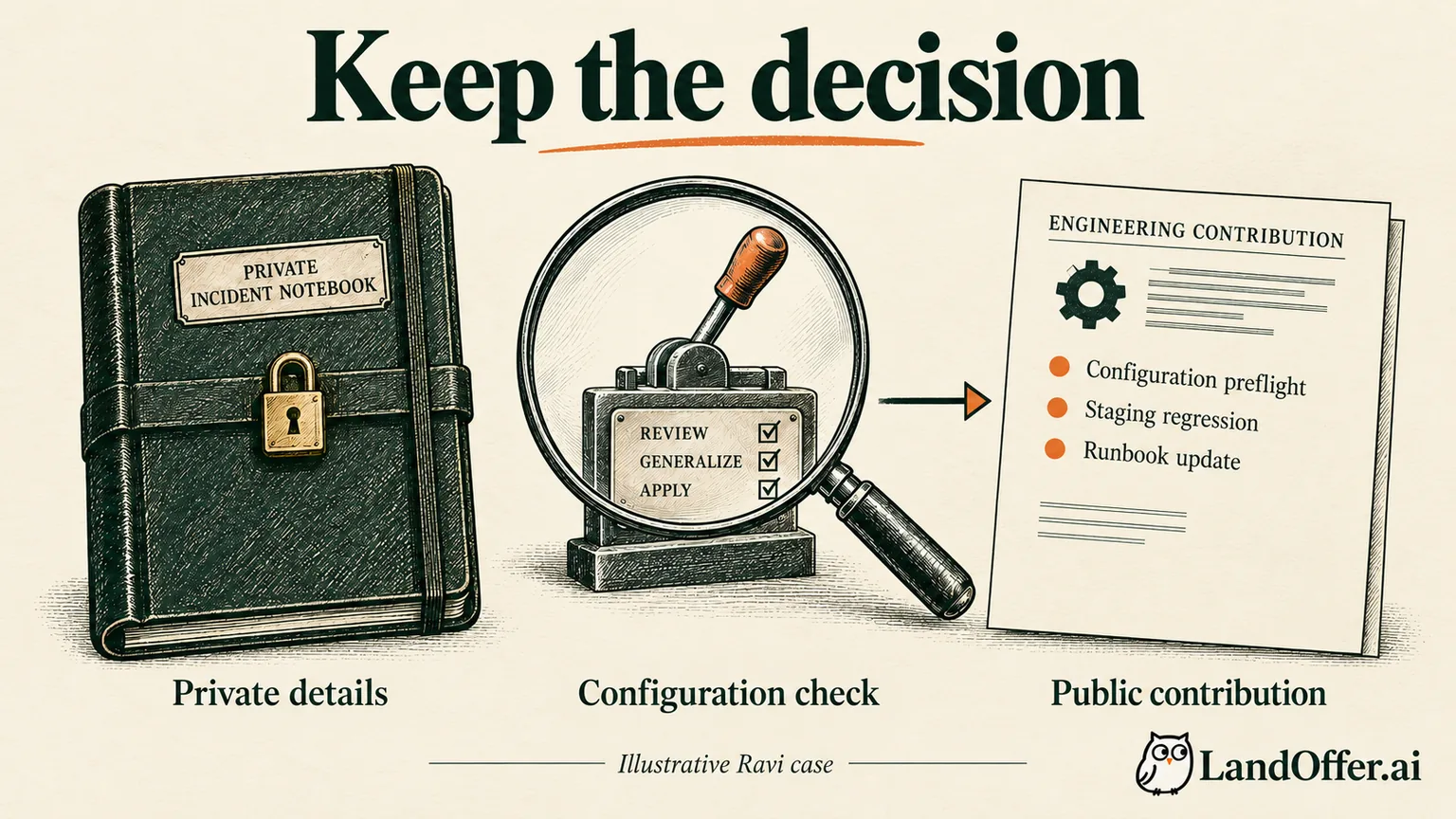
Ravi's second worked asset is a transformation of his fictional private notes. The goal is to retain the engineering decision while removing operational detail that the reader does not need.
| Private note contains | Public resume wording | What remains useful |
|---|---|---|
| Internal environment names and a configuration value that caused rejection | Added a preflight for incompatible deployment configuration | Failure category and safeguard |
| Customer-specific impact and incident timestamps | Investigated application failures during a shared on-call incident | Response responsibility and service context |
| Internal dashboard links and escalation contacts | Verified recovery using the team's established service indicators | Verification method and team boundary |
| Detailed rollback commands and access paths | Documented and rehearsed an application rollback in staging | Preparedness and environment |
Generalization should not change the work. Turning a particular application into “company-wide infrastructure” would remove detail by inflating scope. Likewise, replacing an unknown count with “millions of users” creates a new unsupported claim.
Check combinations as well as individual fields. A customer category, region, date and distinctive incident description may identify an event even after its name disappears. Remove unnecessary identifying combinations while retaining the problem, your contribution and the check.
Do not upload private logs, configuration files or incident reports to a public AI tool to obtain a better bullet. Work from a permitted summary with sensitive information already excluded. Ask an appropriate employer contact when the sharing boundary is uncertain; a recruiter cannot grant permission on the employer's behalf.
If a real credential has already been exposed, editing the resume is not the whole response. GitHub's secret-remediation guidance explains that removing secret text alone is insufficient. Follow the relevant owner, employer and provider process for addressing the exposure, rather than assuming deletion makes it harmless.
Use reliability metrics only with their definitions
A reliability number can look persuasive while leaving the reader unsure what it measures. Was it a target, an observed result, a team measure or an outcome attributable to your particular change? Keep those distinctions visible in your notes and, when material, in the sentence.
The SRE service-level-objectives chapter distinguishes a service-level indicator, a defined measure, from an objective, its target. Working on a service with an availability objective does not establish that you achieved that objective throughout your tenure.
For a measured outcome, retain the service boundary, numerator and denominator where relevant, window and source. A drop in one alert category is not necessarily fewer user-visible failures. A shorter observed recovery in one drill is not a general production recovery guarantee. An average can also conceal a tail that matters to users.
Google's monitoring chapter discusses latency, traffic, errors and saturation. Name the signal your work addressed without publishing internal alert thresholds. “Added error-rate context to an application runbook” can explain a contribution when the thresholds and dashboards must remain private.
Ravi has no defensible uptime or incident-frequency comparison in the stipulated record. His final third bullet therefore reads: “Updated the application runbook with recovery checks and escalation guidance, then handed it over to the shared on-call rotation.” It describes completed work rather than manufacturing a percentage.
Select a coherent experience section
For a release-focused opening, Ravi places the preflight bullet first, followed by the incident action item and operator handoff. For an SRE opening emphasizing response and learning, he starts with the incident contribution and uses the release check to demonstrate preventive follow-through. The underlying facts stay the same.
An early-career candidate can use a personal deployment project or supervised operational work. Label the environment clearly: a home lab, course service and employer production system carry different responsibilities. Configuring a demo does not establish participation in a staffed production rotation.
More experienced candidates should make continuing responsibility visible. Did you maintain the safeguard after rollout, review its exceptions or coordinate another team's adoption? Describe that scope if it is supported. “Owned” is most informative when the reader can tell what you were accountable for over time.
Read the finished section for unsupported absolutes: always, zero downtime, fully secure, all incidents and guaranteed availability. Replace them with the result and conditions you can explain. Check that dates, tools and ownership agree with the rest of the application.
Choose one suitable opening from LandOffer.ai's recent roles. Use the listing to choose relevant evidence. Write a private responsibility map, turn one row into a public bullet and keep sharing within the employer's permitted boundary. Keep the engineering decision and the evidence intact.
Sources and Further Reading
- Google SRE: Release Engineering: repeatable releases, rollout and rollback coordination.
- Google SRE: Postmortem Culture: constructive incident analysis and corrective work.
- Google SRE: Service Level Objectives: indicators, targets and measurement boundaries.
- Google SRE: Monitoring Distributed Systems: operational signals and interpretation.
- GitHub: Remediating a Leaked Secret: why removal alone does not resolve exposure.
Public references checked October 9, 2026. Ravi Shah, Cedarway Logistics and the operational records are fictional; no real incident material or credentials were used.